


How Immediate Action Defines Leadership Authority in High-Stakes Environments
Nic Moretto, SAS-AP®
It was New Year’s Eve. Beach resort, outdoor tiki bar, multiple drinking establishments nearby, and the ball had just dropped. Closing time was approaching — statistically, the highest-risk window of the night. The crowd was loud, distracted, and celebrating. And I was still locked in.
Near the front entrance, I caught the shift before I could consciously name it — a change in body language, a spike in energy, a patron reacting to something the rest of the room hadn’t registered yet. One of the staff, dressed in a Gator costume for the night’s event, had inadvertently spilled the patron’s drink. The patron turned and struck him. A fight broke out.
Without hesitation, I moved. I split the two individuals, secured the patron, and escorted him out before a single bystander had time to react. Very few people in that room even saw what happened.
That last part matters most. The invisible intervention — not the dramatic takedown — is the signature of elite security work. It is what proactive security leadership actually looks like in practice. And it only happens when the operator acts immediately, without deliberation, without waiting for further confirmation.
If I had hesitated — if I had given it another second to “see how it played out” — the situation would have cascaded. Innocent bystanders would have been drawn in. The environment would have deteriorated. A controlled environment would have become an uncontrolled one, and no amount of reactive incident management after that point would have undone the damage.
“Delayed obedience is disobedience.”
I heard that phrase recently, and it stopped me. Because in twenty-plus years of security operations — nightclubs, armed patrols, executive protection, aerospace environments, high-volume annual events — I have watched that principle play out in ways that confirm it completely. The operator who sees the cue and acts immediately controls the outcome. The operator who waits — for more certainty, for permission, for the situation to become undeniable — forfeits that control. And in security, forfeited control rarely comes back clean.
The Cost of Delayed Action
The threat indicators were present. The behavioral profile was there. Every marker of a behavioral threat assessment was satisfied.
So I gave him the benefit of the doubt. I monitored. I waited for confirmation.
He became a serious problem later that night.
I carried that lesson. It cost me nothing irreversible that time, but I understood what I had done. I had seen the pre-incident indicator, processed it correctly, and then disobeyed my own read of the situation. I let hesitation masquerade as patience. I let social pressure masquerade as professionalism. The delay wasn’t a neutral act. It was a decision — and it had consequences.
Another example: working armed security at a high-threat residential complex, I watched this pattern repeat at a team level. Unauthorized individuals would be found on the property — visiting tenants, seemingly benign — and when teams applied leniency, allowed exceptions, and looked the other way, those same individuals became the source of incidents later. Every single time. Not occasionally. Every time. Permissive security team response culture does not neutralize threats — it incubates them.
The delay wasn’t a neutral act. It was a decision — and it had consequences.
This is the pattern that most security professionals have experienced, but few have named: the cue is read correctly, the operator or team knows what they are seeing, and then nothing happens. The moment passes. The situation develops. The outcome deteriorates. And in the debrief, there is always a version of “I thought about addressing it, but…”
That “but” is where authority goes to die.
The Obedience Gap
In security operations, there is a decision-making model most practitioners know — Observe, Orient, Decide, Act (OODA loop). It describes how trained individuals process fluid situations and move toward an effective response. It is well-established, well-tested, and accurate.
But the model assumes that once a decision is reached, action follows. In practice, it frequently does not.
The Obedience Gap: The measurable distance — in time, hesitation, or institutional permissiveness — between the moment a security professional recognizes what action is required and the moment they execute it. The wider the gap, the greater the window for threat escalation, loss of environmental control, and erosion of leadership authority.
The gap is not always individual. Sometimes it is cultural — built into a team’s training, their leadership’s tolerance for ambiguity, or their organization’s reluctance to act on instinct rather than documentation. When leniency becomes policy, the Obedience Gap becomes institutional. And institutional gaps are far harder to close than individual ones.
Understanding where your team’s gap lives — and how wide it runs — is one of the most important diagnostics available to a security leader. Incident prevention through immediate action is not a reaction strategy. It is a culture that must be deliberately built.
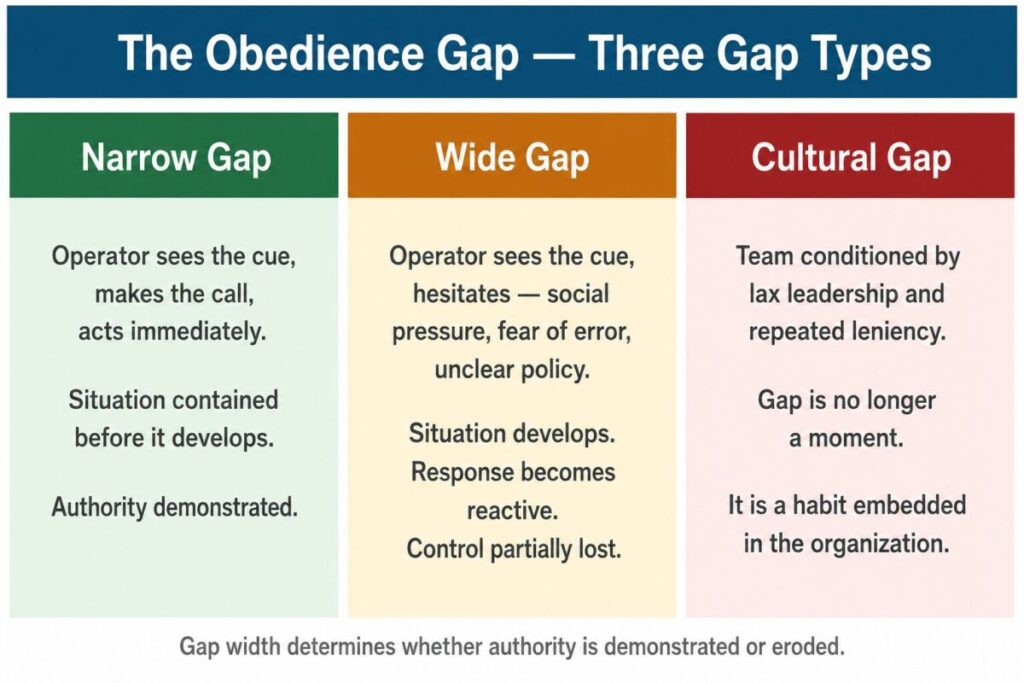
Narrow Gap: The operator sees the cue, makes the call, and acts immediately. The situation is contained before it develops. Most bystanders never know anything happened. This is demonstrated authority.
Wide Gap: The operator sees the cue, hesitates — for social reasons, for fear of being wrong, for lack of clear policy — and waits. The situation develops. Response becomes reactive. Control is partially or fully lost.
Cultural Gap: The team has been conditioned — by lax leadership, by inconsistent enforcement, by repeated leniency without consequence — to default to inaction. The gap is no longer a moment. It is a habit embedded in the organization’s response DNA.[Text Wrapping Break][Text Wrapping Break][Text Wrapping Break]
Elite operators close the gap. Developing operators learn to close it. And leaders — at every level — are responsible for whether their teams’ gaps are narrow or wide.

Demonstrating Authority Through Immediate Action
Authority in security is not primarily a title. It is not a badge, a uniform, or a position on an org chart. Authority is demonstrated through behavior — specifically, through the consistent willingness and ability to act decisively the moment the situation demands it. This is the foundation of proactive security leadership at every level of an organization.
Clients and principals observe this constantly, whether consciously or not. They are watching to see whether the operator at the door handles the problem or defers it. They are watching whether the team lead makes the call or waits for it to be made for them. They are watching whether the security firm’s leadership responds to a concern that same day or lets it sit.
What they are measuring — in every environment, at every level — is the Obedience Gap. The professional who closes it consistently earns authority. The professional who widens it consistently loses it, regardless of credentials or tenure.
Authority is not asserted. It is demonstrated — one immediate decision at a time.
This principle scales directly from the field to the executive level. The security director who delays the difficult conversation with a client, who postpones the staffing decision that everyone knows needs to happen, who sees the organizational problem clearly and waits for it to become undeniable — that leader is operating with the same Obedience Gap as the operator who watched the nightclub patron and waited. The stakes are different. The environment is different. The principle is identical.
Immediate obedience to what you know — to what your training, experience, and judgment are telling you — is not impulsiveness. It is discipline. The untrained individual reacts without processing. The elite operator processes rapidly and acts without hesitation.
It is what separates operators from observers. That distinction — rapid processing followed by immediate action — is what separates operators who control environments from those who simply occupy them.
Closing the Obedience Gap: A Practical Framework for Security Leaders
Whether you are leading a team through a high-volume event detail or running a multi-contract security firm, closing the Obedience Gap requires the same foundational disciplines applied at different scales. Building a security team response culture that defaults to immediate, decisive action does not happen by accident — it is engineered through training, accountability, and leadership modeling.
-
Train the Trigger, Not Just the Skill
Most security training focuses on what to do. Far less training focuses on when, specifically, on building the instinct to act at the moment of recognition rather than waiting for escalation. Pre-incident indicator recognition, behavioral pattern training, and scenario-based exercises that reward early intervention over reactive response all narrow the gap at the individual and team level. The goal is not faster reaction time. The goal is to eliminate the deliberation window entirely. An operator who acts at the moment of recognition — without deliberation — is a force multiplier. One who waits is a liability.
-
Eliminate the Permission Culture
If your team is waiting for real-time authorization before acting on clear indicators, the gap has been institutionalized. Operators need defined authority to act within established parameters — which means clear SOPs, trained thresholds, and leadership that trusts its own hiring and training decisions. Build the standard, train to it, then get out of the way. A team that has to ask permission in the moment has already lost the moment. Every gap in authorization is an open window for threat escalation — and without a defined threat escalation protocol, that window stays open.
-
Debrief on the Gap, Not Just the Outcome
Post-incident reviews that examine only what happened miss the more important question: where was the gap? When was the first pre-incident indicator visible? When was it processed? When was the decision made? When was action taken? The distance between those moments — measured honestly — is where the next training cycle begins. Organizations that debrief on outcomes alone will repeat the same gaps indefinitely. Organizations that debrief on gap width will close them systematically.
-
Model It at the Top
Teams operate to the standard their leaders demonstrate, not the standard their leaders describe. A security director or CEO who models prompt, decisive, unambiguous action — in client communications, in operational decisions, in personnel matters — creates an organization where the Obedience Gap is understood as professionally unacceptable at every level. A leader who tolerates delay in themselves will never eliminate it in their team. The security team’s response culture always reflects the standard set at the top. The gap always starts there.
The Standard
Back to New Year’s Eve. The reason very few people saw what happened in that resort that night is not that nothing happened. It is because the response came before the situation had the opportunity to become visible to the crowd. The intervention was invisible because it was immediate.
That is the standard. Not the dramatic rescue after control is lost. Not the reactive incident management of a situation that escalated while the team deliberated. The quiet, unremarkable intervention that closes the threat window before it opens fully — because the operator acted the moment they knew, not the moment they were certain.
Delayed obedience is disobedience. It is disobedience to your training, to your client’s trust, to the people in that environment who are depending on you to protect them without ever knowing they needed protection.
Authority is not asserted. It is demonstrated — one immediate decision at a time.
The security professionals and leaders who internalize that standard — who close the Obedience Gap in the field, in the briefing room, and in their own leadership behavior — are the ones who build the kind of authority that clients trust, teams respect, and environments depend on. That is the work. Do it without delay.
About the Author
Nic Moretto, SAS-AP® | Founder & CEO, TESS GLOBAL | Tactful Elite Security Solutions | Merritt Island, Florida
Nic Moretto a BBB A+ Accredited, Florida-licensed intelligence-led security firm headquartered on Florida’s Space Coast, recognized as a Top 3 Space Coast Security Guard Service in both 2025 and 2026. A SAS-AP® certified practitioner, fully licensed in the State of Florida, with over twenty years of experience. Nic has built a reputation for proactive, communication-driven security across Florida’s Space Coast and Central Florida region. He is a contributing author to EP Wired and an active voice in operational preparedness and modern security team development.