


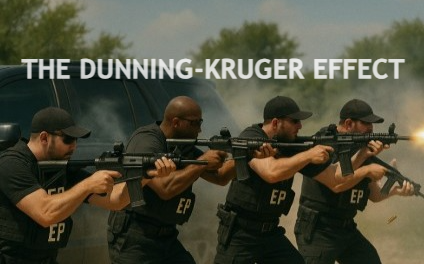
Executive Protection (EP) often conjures a wide range of mental images, from traditional bodyguards to contracted tactical Protective Security Details (PSD) and everything in between. This image is largely shaped by Hollywood portrayals and amplified by self-proclaimed industry “influencers” on social media platforms such as Instagram and YouTube.
A simple online search for “Executive Protection” yields a flood of content representing every niche of the EP career field, along with many questionable portrayals and misinformation. To seasoned professionals, much of this material is easily dismissed as ridiculous noise. Concern, however, arises when individuals promote or publish content without realizing that their messaging and tactics diverge sharply from established industry best practices and standards and border on the absurd. These posts often influence prospective protectors and clients by misrepresenting professional skillsets and services. So what are the consequences for protection professionals when “you don’t know what you don’t know?”
While it’s understood that not everyone in Executive Protection (EP) has the same level of experience or training, there are fundamental skills and core competencies that every practitioner should possess. Unfortunately, this gap in baseline knowledge surfaces far too often in a profession where lives depend on performance. Adding to the issue is a fragmented certification and training landscape across multiple states, which, over the past decade, has helped splinter the EP field even more. As a result, some have drifted away from foundational EP principles and into the nonsensical theatrical periphery of the profession.
This divergence has created other problems and a growing trend: Executive Protection providers branching out into areas beyond their scope in pursuit of new revenue streams. Unfortunately, in some cases, this expansion follows a “fake it till you make it” approach to business development. Is service diversification inherently bad? Not at all, but it becomes problematic when quantity takes precedence over quality, and even worse when the firms offering these services lack the necessary training, licensing, certification, or expertise to succeed.
When you knowingly exaggerate your qualifications, you’re expressing unprofessional behavior. When you do it unknowingly, you’re exhibiting the Dunning-Kruger Effect, a cognitive bias in which individuals with limited knowledge or experience in a professional area significantly overestimate their abilities. In Executive Protection, where your decisions can determine the safety of others, this blind overconfidence, particularly among the inexperienced, is not just dangerous, it’s potentially lethal. Recognizing and addressing this bias is essential to ensuring the safety of our protectees and maintaining the credibility of our profession.
Understanding the Dunning-Kruger Effect
First studied by psychologists David Dunning and Justin Kruger in 1999, the psychological effect describes how people who lack skills in a particular area are often unaware of their lack of expertise and rate their abilities far higher than warranted. Ironically, it’s this very lack of knowledge that prevents them from realizing how much they don’t know. This effect is almost the opposite of “Impostor Syndrome,” where someone can feel inadequate, but possesses the necessary skills; conversely, under Dunning-Kruger, you are overconfident in your knowledge or abilities and don’t possess the needed skills.
In professions requiring high levels of precision, planning, and situational awareness, like EP, this bias can have disastrous results. It’s reflected when protectors with minimal training, experience, or protective skills assume they’re ready to handle every EP assignment.
Executive Protection: It’s performance, not hype
Median spending on executive protection for top corporate officers has risen 16% this year, according to new data from Equilar, which reviewed financial filings for the 500 largest U.S. public companies by revenue (Reuters). With this sudden attention and disbursement on personal protection, marketing for protective services has reached an all-time high. The EP career field is not about appearances or theatrical displays for the benefit of clients or onlookers, but for some, dramatized marketing targeting the inexperienced pays the bills. Despite the recent public and corporate interest in personal protective services, what is increasingly promoted on social media is often fantasy for the benefit of the producers’ bank accounts.
At its core, EP involves proactive threat mitigation, precision planning, and logistical execution under pressure. It’s about being the calmest, most capable, and best-prepared person in the room when the unexpected occurs. This profession demands more than a sharp suit and stoic demeanor. It requires:
- Critical thinking under stress – the ability to make fast, sound decisions with often incomplete information.
- Relentless preparation – conducting advance work, route planning, contingency development, and knowing your environment better than anyone else.
- Discretion and professionalism – maintaining a low profile while upholding the highest standards of conduct and client confidentiality.
- Interpersonal intelligence – the awareness to manage interactions with protectees, teams, vendors, and the public tactfully and effectively.
- Physical and mental resilience – long hours, changing environments, and the responsibility for another person’s life require both stamina and clarity.
In short, EP isn’t about being seen; it’s about being effective,…without anyone noticing.
How the Dunning-Kruger Effect is reflected in EP
Despite the obvious complexity and responsibility of the EP role, the career field, especially in the age of Instagram Reels and YouTube Shorts, is saturated with overconfident beginners and sometimes “not-so-beginner EP Cool Guys” who are quick to provide “content” on their latest assignment or pseudo-training course. It’s easy to spot, but examples include:
- A new EP employee (trained or not) referring to themselves as a “security consultant” and providing “advice” on every aspect of the security industry.
- A bouncer-turned-bodyguard who assumes they are an expert in close protection and believes proximity equals correct protective coverage without understanding their role or responsibility.
- Social media “EP trainers” relying on military service experience who post tactical PSD content or incorrect EP tactics videos with limited, sketchy, or unverifiable real-world protective expertise.
- Individuals promoting gear, guns, fighting, and the “lifestyle” but puzzled by simple protection fundamentals like route planning or protective operational advance procedures.
- In most cases, these faux experts are not acting maliciously. Most genuinely believe they’re qualified to perform the most state-of-the-art EP duties. That’s the trap of the Dunning-Kruger Effect, and in this line of work, that delusion is dangerous.
The Cost of Overconfidence
As noted earlier, this is not a profession where you can “fake it until you make it.” That certificate from a two-day online course in EP fundamentals does not effectively prepare you or equate to operational readiness. True competence in EP comes from hundreds of hours of structured training, scenario-based learning, and real-world experience.
Protective operations demand more than theoretical knowledge; it requires sound judgment, refined skills, and the ability to perform under pressure when threats emerge. Without that foundation, you’re not just taking unnecessary risks, you’re creating dangerous vulnerabilities.
A lack of proper training and real-world experience doesn’t just jeopardize your own safety; it compromises the safety of your protectee, undermines the effectiveness of your team, and exposes everyone to unnecessary threats. In EP, failure isn’t an individual consequence; it ripples outward, impacting the very people you’ve been entrusted to safeguard.
The immediate results of the Dunning-Kruger Effect in daily EP operations can be seen when:
- Worst Case: The protectee’s safety is at risk. Unprepared protectors may fail to recognize threats, avoid them, or respond effectively/appropriately under pressure. In this profession, we have many responsibilities, but one job.
- Some company owners and trainers promote flawed security practices and overstate their expertise, often without even understanding basic protective operations best practices. Always verify core job knowledge and professional backgrounds before accepting training or employment.
- Legal exposure increases, especially when local, state, or international laws are misunderstood or ignored. This is, unfortunately, common and has been seen in the arrests of protectors internationally for overzealous behaviors and assaults.
- Team dynamics suffer as seasoned professionals are forced to compensate for the misgivings or recklessness of others. More often than not, after being dismissed for performance issues, these protectors refuse to recognize their faults. Some even start new businesses and perpetuate their failed protective coverage models, because the industry is largely unregulated and doesn’t recognize or care to address it.
- Over time, the industry’s credibility erodes, especially when high-profile failures become public. For every polished EP video online, there are twenty more reflecting EP fails. We could all do without another video of you walking your protectee into an uncontrolled crowd on the way to a locked limo door.
- Overconfident protectors often resist advanced training, dismiss mentorships, reject constructive feedback, and/or double down on poor EP practices, reinforcing a dangerous cycle. If you’ve never seen this, just comment on someone’s latest “I’m cool” post on LinkedIn and wait for the tidal wave of rebuttals.
How to Address the Dunning-Kruger Effect in EP
Fortunately, the Dunning-Kruger Effect can be overcome, not with more confidence, but with more competence. It starts with experienced supervision and honest exchanges between professionals regarding performance and protective operational coverage in your workplace and the EP community. While personal critique is not usually something most in this field enjoy or entertain (you know who you are), without honest dialogue and open conversations, poor protection continues. Here’s how the EP community can address these issues and elevate the career field at the same time:
- Promote professional humility by normalizing the idea that you don’t know everything. We should encourage continuous protective operational training and continue to pursue EP best practices.
- Encourage protectors at all levels to ask questions, seek feedback, and stay curious. Sometimes asking “why” you are doing a specific task will help you understand if the person directing you knows the basics.
- Don’t be afraid to challenge anyone who identifies themselves as an “expert” in this field. Everyone is an expert (not really), just read their LinkedIn bio.
- Champion best practices and elevated standards in Training. Your State Certified or Department of Veterans Affairs-approved school doesn’t mean anything if it doesn’t provide you with the skills necessary to work in EP at the highest levels.
- Seek out, support, and attend accredited EP training programs. Research the accreditation and talk to graduates about their positive and negative experiences.
- Avoid “influencer instructors” and instead focus on proven and vetted professionals with actual EP (not PSD) operational experience. Not everyone who teaches has experience or has even worked in the field.
- Online EP training won’t advance your career. Executive Protection is a hands-on profession that requires mastering physical tasks under pressure, something no virtual course can deliver. At best, they waste your time; at worst, they just drain your wallet.
- Seek out mentorship and peer review. If you want to know something, you just need to ask. The large network of professionals in this field is happy to discuss almost anything when called upon. If you can’t get answers from someone, it’s usually because they don’t know and/or don’t want to embarrass themselves.
- Encourage a culture of learning by pairing less experienced professionals with seasoned ones. Most of us learn best by doing, and there’s nothing better than doing it right the first time.
- Constructive (private) criticism and team after-action reviews should be standard practice. Table tops and post-operational discussions help everyone learn and apply correct best practices to ensure mistakes are not repeated.
- Separate the “smoke and mirrors” behavior from reality. This is harder than it sounds, but if you’re watching instructional videos that include tactical vests, schmedium black t-shirts, automatic weapons, and blonde models, you’re watching the wrong thing.
- Discourage the performative aspects of the job. The best protectors are often the least seen, not the ones with flashy tactical videos or aggressive branding. Be prepared, though, when you call out influencers, you are impacting their bottom line, and the one thing they do “protect” well is their branding and income.
- And most importantly, reward “Quiet Competence.” Recognize those team members who operate effectively without the need for the spotlight. In this field, success is often invisible: the crisis that never happened, the threat that was avoided, and the protectee who continued to work, oblivious to any security issues.
Conclusion
Executive Protection is not a “game,” lifestyle, or aesthetic. This demanding profession requires humility, skill, and relentless attention to detail. The Dunning-Kruger Effect is particularly concerning in this environment because the stakes are so high and the consequences so real. If you’re new to the career field, the best thing you can do is admit what you don’t know, seek quality training, and invest in pursuing real-world experience. If you’re a seasoned professional, your responsibility is to continue learning, call out and correct dangerous practices, and focus on safeguarding the lives entrusted to your protection. In the end, the most professional thing we can say in this field might be: “I don’t know,…but I’ll find out.”