


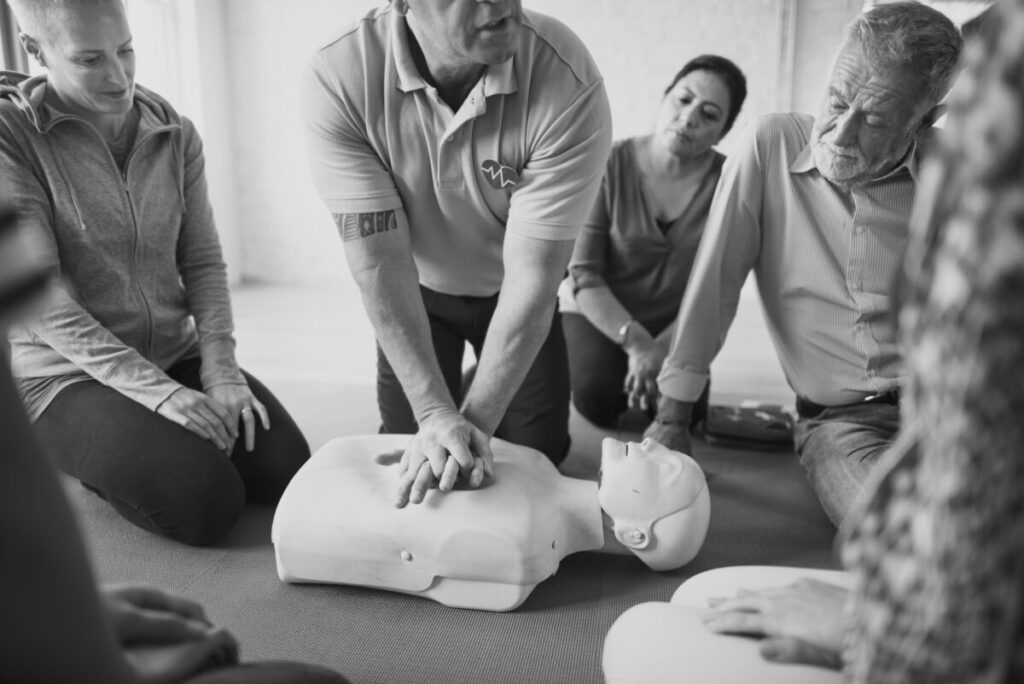
Medical emergencies can happen at any time, including cardiac arrest, choking, severe bleeding, allergic reactions, falls, burns, or sudden illness. For executive protection professionals, the ability to provide immediate first aid or CPR can become an important part of the response while emergency medical services are being activated and brought to the scene.
CPR and first aid certification do not turn a protection professional into a medical provider. Instead, it provides a foundation for recognizing emergencies, taking appropriate immediate action, and understanding when professional medical assistance is required.
What Is the Difference Between CPR and First Aid?
CPR, or cardiopulmonary resuscitation, is used when a person is in cardiac arrest or is not breathing normally. It involves chest compressions and, depending on the responder’s training and circumstances, rescue breaths. Modern CPR training also commonly covers the use of an automated external defibrillator (AED).
On the other hand, first aid is broader and covers more techniques. It involves the initial care provided to someone experiencing an acute illness or injury. The American Heart Association defines first aid as initial care intended to preserve life, reduce suffering, prevent further injury or illness, and support recovery.
A first aid course may therefore address situations such as bleeding, wounds, burns, fractures, choking, allergic reactions, environmental emergencies, and other common injuries or illnesses.
For an executive protection professional, the two areas complement each other. A detail may need to deal with a medical emergency that is immediately life-threatening, as well as less critical injuries that still require prompt attention.
Why Medical Response Matters in Executive Protection
Protective professionals often work in environments where they are responsible for maintaining the principal’s safety while coordinating movement, access, transportation, and emergency response.
Without the proper training, a medical emergency can complicate all of those responsibilities.
For example, a principal could experience a cardiac emergency during travel, sustain an injury at an event, or suffer a serious reaction while away from immediate medical care. The protection team may be the first trained personnel available to recognize the problem and begin an appropriate response.
The 2025 American Heart Association guidelines emphasise early recognition of cardiac arrest, high-quality CPR, and prompt defibrillation as key interventions.
This does not mean every executive protection professional needs advanced medical qualifications. It does mean that basic emergency medical knowledge can form an important part of a broader protective skill set.
What Does CPR Training Usually Cover?
CPR training is designed to teach responders what to do during a life-threatening emergency before more advanced care becomes available.
Core topics commonly include recognising cardiac arrest, activating the emergency response system, performing chest compressions, providing rescue breaths when appropriate, and using an AED.
The exact curriculum depends on the provider and certification level. Current CPR education should also reflect the latest evidence-based guidelines. The AHA’s 2025 guidelines cover adult, pediatric, and neonatal resuscitation, with separate recommendations for lay rescuers and healthcare professionals.
What Does First Aid Training Cover?
First aid training covers a much wider range of emergencies than CPR alone.
Depending on the course, participants can learn how to assess an injured or ill person, control bleeding, manage wounds and burns, respond to choking, recognise certain medical emergencies, and provide appropriate initial care while waiting for emergency services.
An important part of first aid is also recognising the limits of the responder’s role. The AHA notes that first aid competencies include recognising and prioritising the need for care, providing appropriate assistance, recognising limitations, and seeking additional care when necessary.
For protection professionals, that distinction is particularly important. First aid is about providing appropriate immediate assistance, not independently diagnosing or treating medical conditions beyond the responder’s training and legal scope.
Where Does AED Training Fit In?
An automated external defibrillator is designed to analyse a person’s heart rhythm and, when appropriate, deliver an electrical shock.
AED training is commonly incorporated into CPR courses because CPR and early defibrillation are closely connected components of the response to cardiac arrest. The AHA’s current adult Basic Life Support guidance specifically addresses AED use alongside CPR.
For executive protection teams, familiarity with AEDs can be particularly relevant when working at hotels, corporate facilities, airports, event venues, or other locations where an AED may be available.
Knowing that an AED exists nearby is not the same as knowing how to use one. Practical training helps responders become familiar with the equipment and the sequence involved in deploying it.
CPR and First Aid Certification Levels
Not all medical training provides the same level of knowledge or authority.
Basic CPR and first aid certification is generally designed for people who may need to respond to an emergency but are not healthcare professionals. Other courses are designed for professional rescuers, healthcare workers, or individuals with more specialised responsibilities.
Basic Life Support (BLS), for example, is generally more comprehensive than a standard community CPR course and is commonly intended for healthcare professionals and professional responders.
Executive protection professionals therefore need to look beyond the word certified. The relevant questions include what the course teaches, who it is designed for, how much hands-on training it provides, and whether it matches the requirements of the role.
Is Online Certification Enough?
Online training can provide useful theoretical knowledge, but practical emergency skills are different from purely academic learning.
For example, the American Red Cross states that online-only CPR courses do not qualify for workplace certification where an in-person skills session is required. Its workplace-eligible certification requires participants to complete an in-person skills component.
This distinction matters in executive protection because knowing the correct procedure and physically performing it are not necessarily the same thing.
A protection professional may understand how CPR works but still need practical experience to develop confidence with compressions, AED operation, positioning, and other hands-on skills.
How Long Does Certification Last?
Certification is not permanent.
Requirements vary by training provider, employer, jurisdiction, and certification type. For example, the American Red Cross states that its CPR certification is valid for two years and offers renewal courses for current certificate holders.
That is why the expiration date should be treated as part of professional credential management. A protection professional should know when their certification expires and understand what their employer, client, licensing authority, or contract requires.
More importantly, maintaining a certificate should not be confused with maintaining competence.
Certification Is Only One Part of Medical Preparedness
A current certificate demonstrates that a person has completed a particular course. It does not guarantee that they will perform perfectly during a real emergency.
Skills can deteriorate without practice, particularly when they are rarely used.
The 2025 AHA resuscitation education guidance places emphasis on practical education strategies, including deliberate practice, feedback devices, teamwork, leadership training, and scenario-based approaches.
For executive protection teams, regular practical refreshers can complement formal certification. Training scenarios can also help personnel consider how medical response fits alongside the wider protective operation.
Integrating Medical Response Into the Protective Detail
Medical preparedness should not necessarily be treated as a completely separate responsibility from executive protection.
A protection team may need to consider medical response during advance work, route planning, venue assessments, travel, and event operations. This can include identifying nearby medical facilities, understanding emergency access points, locating AEDs, and establishing how emergency services will be contacted.
The objective is not for every protection professional to become a medic. It is to ensure that the team understands its capabilities, limitations, and procedures before an emergency occurs.
This becomes especially relevant when operating in unfamiliar locations or environments where emergency medical response times may vary.
CPR, First Aid, and Advanced Medical Training
Basic CPR and first aid should also be distinguished from advanced tactical or emergency medical training.
Some executive protection professionals pursue additional qualifications that provide significantly more extensive medical knowledge and practical capability. These may be particularly relevant to roles involving remote environments, high-risk travel, or assignments where access to professional medical care may be delayed.
The appropriate level of training depends on the role, environment, client requirements, and applicable regulations.
A standard first aid certificate should not be presented as equivalent to advanced medical training, just as advanced medical training does not replace the responsibilities of licensed healthcare professionals.
What Should Executive Protection Professionals Look for in a Course?
When selecting a CPR or first aid course, protection professionals can consider several practical factors.
The course should use current, evidence-based guidance and provide meaningful hands-on practice. The certification should clearly state what was taught, who issued it, and when it expires.
It is also useful to consider the intended audience. A course designed for the general public may provide a solid foundation, while a course designed for professional responders may better reflect the demands of a protection role.
For executive protection teams, scenario-based training can provide additional value because it allows medical response to be considered within the context of movement, communications, team coordination, and scene safety.
The Role of Medical Skills in Modern Executive Protection
Executive protection continues to involve more than physical security. Professionals may need to coordinate transportation, intelligence, logistics, communications, emergency planning, and medical response as part of the same operation.
CPR and first aid certification does not cover every medical scenario a protection professional might encounter. It does, however, provide a foundation for responding to emergencies that can occur anywhere and at any time.
The most important distinction is between having a certificate and being prepared to respond. Certification establishes formal training, while continued practice, appropriate advanced education, and integration with the protective plan help turn that training into a practical capability.
For executive protection professionals, medical preparedness is ultimately another part of being ready for the unexpected.