


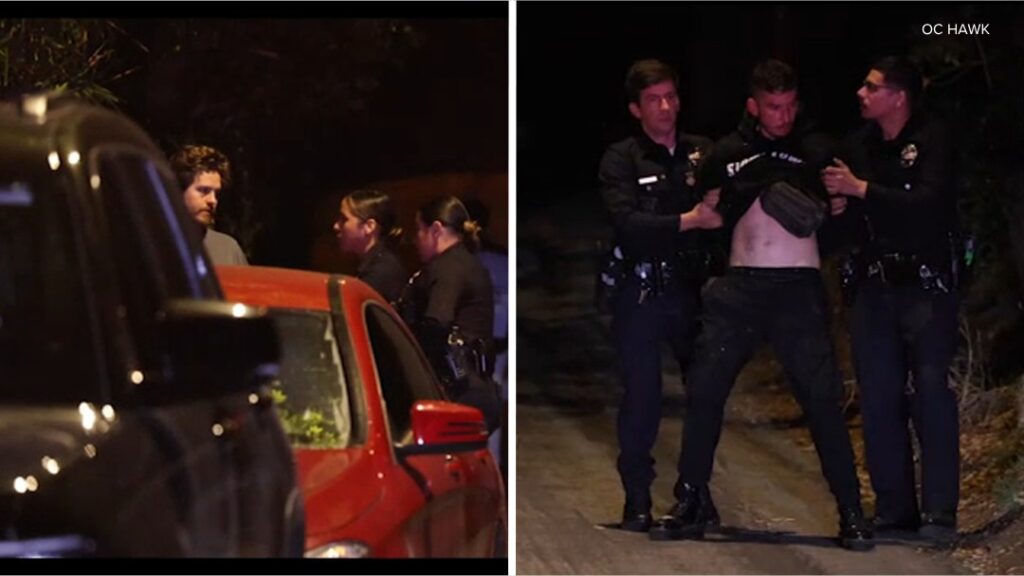
A late-night incident at the Hollywood Hills residence of Dylan Sprouse and Barbara Palvin has brought renewed attention to the evolving security risks faced by high-profile individuals in residential environments.
Actor Dylan Sprouse Restrains a Trespasser
Shortly after midnight on April 17, an unidentified male entered the couple’s property. According to reports, Sprouse confronted the individual and initially held him at gunpoint before tackling and restraining him on the ground.
Palvin contacted emergency services around 12:30 a.m., with responding officers arriving to find the suspect already detained outside the property.
Police Response and Legal Outcome
The Los Angeles Police Department later clarified that the situation was being treated as trespassing rather than a confirmed burglary attempt.
Although Sprouse was reportedly armed during the confrontation, no firearm was discharged. The suspect was taken into custody, not for the trespassing itself, but due to an unrelated outstanding warrant.
No injuries were reported, and the couple declined to press charges related to the intrusion.
Not an Isolated Incident
Sources close to the situation indicated that this was not the first time an individual had attempted to access the couple’s home without permission. While details of previous incidents remain limited, repeated targeting, particularly at the trespassing level, can signal a developing pattern rather than a one-off event.
This aligns with a broader trend affecting public figures, where low-level boundary testing often precedes more serious security breaches. Increased visibility through media exposure and social platforms continues to make residential locations more vulnerable to unwanted attention.
Incidents like this are rarely isolated when viewed in the broader context of celebrity security. Over the past decade, unauthorised access to private residences has become a recurring issue for high-profile individuals, cutting across actors, musicians, athletes, and influencers alike.
In many cases, these breaches begin as low-level intrusions like trespassing, loitering, or attempted entry, before escalating into more serious incidents. What appears opportunistic on the surface is often rooted in a mix of factors: increased public visibility, oversharing of location data, predictable daily routines, and, in some cases, fixation-driven behaviour from individuals who feel a personal connection to the target.
Several well-documented cases illustrate how quickly these situations can evolve. Properties belonging to figures like Taylor Swift and Rihanna have been repeatedly targeted by intruders over the years, with incidents ranging from stalking to unauthorised entry and even occupation of the property. In many of these cases, the individuals involved had prior attempts or warning signs that went unaddressed or underestimated.
Similarly, break-in attempts at residences linked to figures such as Drake and Post Malone have reinforced how visibility and perceived accessibility can create risk, regardless of location or property value. High walls, gated entries, and premium neighbourhoods may deter casual intrusion, but they are far less effective against determined individuals.
A consistent theme across these cases is the concept of “boundary testing.” Intruders often start by probing the limits – entering open gates, approaching doors, or remaining on the property long enough to assess response times. If those actions do not trigger immediate consequences, the likelihood of escalation increases.
There is also a growing overlap between digital exposure and physical risk. Real-time social media posts, tagged locations, and publicly accessible property details can all contribute to building a target profile. For individuals with large followings, even indirect information, such as identifiable landmarks or routine habits, can be pieced together to narrow down access points or timing.
For EP professionals, this wider pattern reinforces a critical point: most residential breaches are not purely random. They are enabled either by gaps in physical security, delays in detection, or a lack of proactive threat assessment. The difference between a trespassing incident and a full-scale intrusion often comes down to how early those warning signs are identified and addressed.