


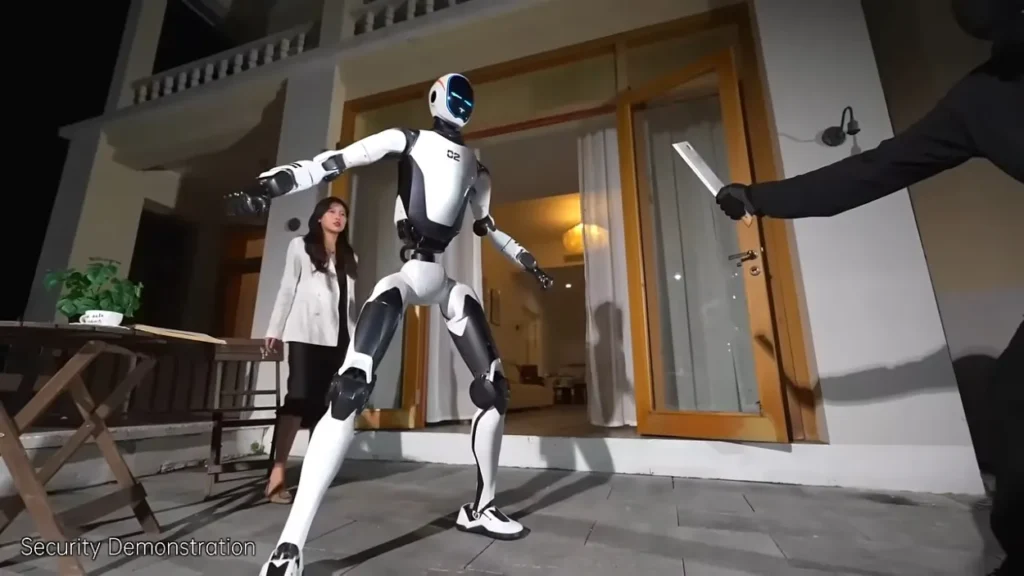
Chinese robotics manufacturer Unitree Robotics has unveiled the H2-X Kung Fu Legend Guardian, a humanoid robot designed to demonstrate potential applications in security, personal protection, and emergency response.
Introduced in October 2026, the H2-X attracted attention after Unitree released a promotional video showing the robot performing martial arts movements, executing acrobatic jumps, and intervening in simulated dangerous situations. Among the demonstrations, the robot steps between a woman and a knife-wielding attacker, lifts the front of a vehicle to free a trapped person, and moves a child-sized mannequin away from an approaching car.
The footage also highlights the robot’s physical capabilities. The H2-X delivers powerful punches and kicks that can dent vehicle bodywork, performs somersaults, and lands on its feet after jumping from a platform about four meters high.
While these demonstrations are not evidence of operational readiness, they introduce an interesting development for the EP industry: the potential integration of humanoid robots into security and protective operations.
Could Humanoid Robots Have a Role in Executive Protection?
The H2-X demonstration raises questions about how robotics could eventually support executive protection teams, particularly in environments where physical hazards, repetitive monitoring tasks, or emergency response requirements create additional demands.
In theory, humanoid robots could assist with certain security functions, including perimeter monitoring, surveillance support, access control, and operating in hazardous environments. Their physical strength and mobility could also help in emergencies involving debris, damaged vehicles, or other obstacles that would be difficult for a human operator to handle safely.
For executive protection professionals, however, the most relevant question is not simply how much force a robot can generate. It is how reliably it can identify threats, interpret human behavior, and respond without creating additional risks.
A bodyguard has to continuously assess their surroundings, recognize potential threats, understand the principal’s movements, and make decisions based on rapidly changing circumstances. These responsibilities require situational awareness, sound judgment, and the ability to adapt to unpredictable situations.
The H2-X promotional footage does not establish that the robot can independently perform these functions.
Autonomy and Reliability Remain Major Questions
One of the most important unanswered questions concerns the H2-X’s level of autonomy.
Unitree has not clarified whether the robot performed the demonstrated actions independently, followed preprogrammed movements, or was remotely controlled. Consequently, the footage does not prove that the system can independently recognize an emerging threat, assess the situation, and select an appropriate response.
This distinction matters in executive protection. A robot that can execute a predetermined defensive movement is fundamentally different from one capable of making independent security decisions in an uncontrolled environment.
Physical safety also raises questions. Even though the H2-X demonstrates considerable strength and balance, its ability to operate safely around people requires further evaluation. An intervention involving a moving vehicle, an armed individual, or a crowded environment could produce unintended consequences if the robot misinterprets the situation.
Reliability is another consideration. Security operations require equipment that performs consistently under pressure, including in unfamiliar environments and changing weather conditions. A successful demonstration does not establish that a robot can maintain the same performance during prolonged operational deployment.
What Is Known About the H2-X?
Unitree has released limited technical information about the H2-X. The company claims the robot can operate for up to eight hours while standing, although it has not clarified how this figure translates to periods of movement or physically demanding activity.
The model is believed to be based on the company’s existing H2 humanoid platform, which stands approximately 182 centimeters tall, weighs around 70 kilograms, and has 31 degrees of freedom.
For comparison, the standard H2 model has a reported battery life of approximately three hours. Unitree lists its starting price at $29,900.
The manufacturer has not announced the H2-X’s price, commercial release date, or detailed specifications. Its intended operational capabilities also remain unclear.
The Future of Robotics in the Protection Industry
The H2-X is part of a broader movement towards humanoid robotics capable of performing increasingly complex physical tasks. As manufacturers improve mobility, balance, sensors, and artificial intelligence, the range of potential applications continues to expand.
For the EP industry, these developments are worth monitoring. Humanoid robots could eventually become useful supporting tools for security teams, particularly in surveillance, monitoring, logistics, and emergency response.
However, replacing a human protection professional involves considerably more than reproducing physical strength or defensive movements. Threat assessment, discretion, communication, adaptability, and sound decision-making remain central to effective executive protection.
The H2-X currently demonstrates what humanoid robots can physically accomplish in controlled scenarios. Whether they can eventually contribute to real-world protective operations will depend on advances in autonomy, reliability, safety, and human-robot coordination.
For now, the technology represents an emerging development to watch rather than a practical replacement for human executive protection agents.