



How an Executive Protection Detail Is Assembled Before the Principal Moves — Assets, Ground, Team, Rules, and the Final Check
By Nic Moretto, SAS-AP® | Founder & CEO, TESS GLOBAL | Tactful Elite Security Solutions | Merritt Island, Florida
A protective detail is not a number of people. It is a set of functions, assembled in order, and the order is not a preference.
You cannot assign roles until you know what the ground requires. You cannot know what the ground requires until you know what you are working with — which vehicles, whose authority to drive them, what access the environment allows, what your license actually permits there. And you cannot settle the rules of engagement after the team is standing in the lobby, because by then the client has formed their own expectations and somebody is going to act on them.
Most details get assembled backwards. The client asks for four agents. Four agents get scheduled. Then somebody works out where to put them, usually on arrival, usually out loud.
Built forward, it runs the other way. Assets first, because they define what the operation is capable of. Ground second, because it defines what the operation is constrained by. Team third, because roles exist to cover what the first two stages revealed — not to fill a headcount. Rules fourth, because authority has to be established before anyone needs it. And the final check last, because an operation that has never been tested is an assumption with people standing in it.
The literature on executive protection is not thin. Dale June’s Introduction to Executive Protection — a standard reference in this field since the late 1990s, now in its fourth edition with Elijah Shaw — and Robert Oatman’s body of work, including the Executive Protection chapter in ASIS International’s Protection of Assets Manual, established what a protective operation consists of. What the literature spends less time on is the order in which those components get assembled, and what each stage constrains downstream.
A note on where this sits. Security program development is the organizational layer — what an enterprise commits to, funds, staffs, and governs; I covered its failure points in The Illusion of Protection, EP Wired, August 2026. This is the layer underneath it: one detail, one movement, and who owns what before anyone deploys. A mature program still produces poorly assembled details if nobody works the sequence.
Six stages. Each one produces something the next one requires.
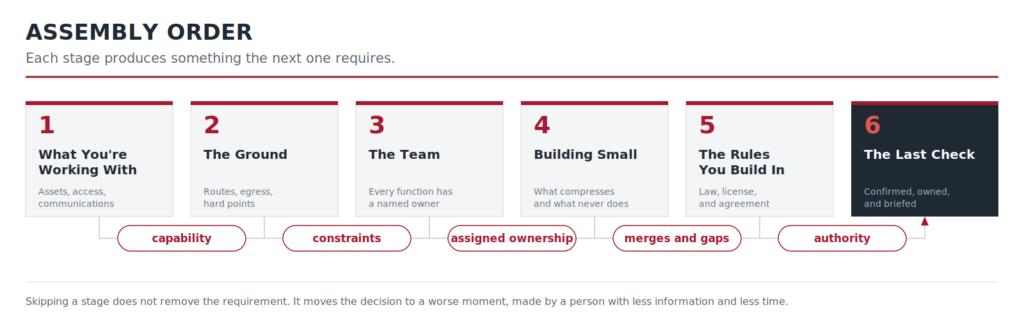
STAGE 1 — WHAT YOU’RE WORKING WITH: ASSETS, ACCESS, AND COMMUNICATIONS
Capability is not what your team can do. It is what your team is permitted to do, in this vehicle, in this environment, under this license.
Assets determine capability. Capability determines the plan. Build the plan first and you discover your constraints on movement day, in front of the client, which is another way of saying you improvise.
Ownership Status Is an Operational Variable
The most common assumption in vehicle planning is that a vehicle is a vehicle. Whether an asset is owned by the principal, owned by the organization, leased, chartered, or rented changes what you are permitted to do with it, who carries liability when something goes wrong, and how much you actually know about its condition and history.
A principal-owned vehicle is a known quantity. You inspect it on your schedule, control who has access to it, establish a maintenance baseline, and control where it is stored between movements. You can also assume anyone conducting surveillance has already identified it. A recognizable vehicle tied to a recognizable principal is a fixed signature. That is a trade-off to plan around, not a flaw.
A rented or chartered vehicle inverts every one of those factors. You gain anonymity and lose control. You do not know who serviced it, who drove it last, or who had access to it before you took possession. Your inspection has to be more thorough, not less, precisely because you have no baseline.
Rental agreements also carry contractual restrictions that most practitioners never read until they matter — authorized driver clauses, geographic limitations, prohibitions on certain uses, and insurance terms that may not extend to a vehicle operated in a protective capacity. If your evacuation plan depends on a driver who is not listed on the agreement, you do not have an evacuation plan. You have an incident waiting for an attorney.
The same logic runs through every asset class. A principal-owned aircraft operates under different access, scheduling, and security assumptions than a charter. An owned vessel is not the same environment as a chartered vessel with a crew you did not select and cannot vet. Ownership status is an input to everything downstream, and it belongs in the operational record alongside the route and the contacts.
Credentials Are Environment-Specific
This is where I see confident, experienced practitioners get it wrong, and the error is worth naming plainly.
A Transportation Worker Identification Credential — TWIC — governs unescorted access to secure areas of maritime facilities and vessels regulated under the Maritime Transportation Security Act. It is a port and maritime credential. It does not authorize you to drive onto an airport ramp.
Airside vehicle access is governed by that airport’s own security program and, at commercial airports, by federal airport security regulation. Practically, that means a badge issued by that specific airport authority, often with a separate vehicle operator endorsement distinguishing movement from non-movement areas, or escorted access arranged through the fixed base operator. Requirements vary between a large commercial airport and a general aviation FBO, and they vary again between airports in the same state.
“Can we drive the principal to the aircraft?” is a question with a location-specific answer that gets resolved before deployment, in writing, with the authority that actually controls that access. Not assumed. Not resolved at the gate with the principal in the back seat.
FIELD NOTE — TWIC: What It Is and What It Isn’t
The Transportation Worker Identification Credential is required by the Maritime Transportation Security Act for workers needing access to secure areas of U.S. maritime facilities and vessels. TSA conducts the security threat assessment and issues the credential; questions on card usage and facility access requirements go to the U.S. Coast Guard. The program is administered jointly by the two agencies.
For protection practitioners, the operational value is unescorted access. Without it, entry into restricted maritime zones depends on an escort — which means your movement timing is controlled by someone else’s availability. On a detail, that is not an inconvenience. It is the loss of a variable you assembled the operation to control.
TSA advises enrolling — including renewals — a minimum of 60 days before the credential is needed, noting processing for some applicants may exceed 45 days. Practitioners who wait until a maritime assignment appears on the calendar are already late. A secondary benefit worth knowing: many TWIC holders meet the criteria for TSA PreCheck and can use the CIN on the back of the card as a known traveler number.
What it does not do: authorize airside vehicle access. Airport ramp access runs through the individual airport’s security program — a badge from that airport authority, or escorted access through the FBO. Two environments, two credentials, two separate questions.
Source: TSA (tsa.gov/twic) and the U.S. Coast Guard. Verify current requirements before relying on any of the above.
Land, Water, and Air Are Different Legal Environments
When the principal changes operating environment, more changes than the vehicle.
Jurisdiction changes. On land, you are typically under state and local authority with a clear law enforcement partner. In the maritime environment, jurisdiction shifts with distance from shore and vessel flag, and the responding authority may be federal rather than local. In the air, the environment is federally regulated end to end, and the aircraft’s captain holds authority that supersedes yours.
Legal carriage changes. What you may lawfully carry on land does not transfer to an aircraft or, in many cases, to a vessel — and it does not transfer across a border. Stage 5 addresses this in full, but it becomes a constraint here, because it determines what the team is capable of before a single role has been assigned.
Response time changes. On land, emergency services are minutes away in most environments. On the water, that calculation changes entirely, which is why organic medical capability becomes progressively harder to justify omitting as response time increases.
Communications change. Radio propagation, cellular coverage, and platform availability are not consistent across environments. A communications plan that works in a hotel does not automatically work on a vessel or an airfield.
I am keeping the maritime treatment brief here deliberately. That environment carries enough distinct doctrine — vessel security, port access, underway operations, jurisdiction at sea — that it does not compress into a subsection without losing what matters. What appears above is the constraint the environment places on asset planning, not coverage of the environment itself.
Communications Platform Selection Is an Intelligence Decision
Most teams choose a platform based on what is convenient. That is the wrong criterion.
The principal’s movement schedule is intelligence. The route is intelligence. Post assignments, arrival windows, and evacuation triggers are intelligence. All of it travels across whatever platform the team is using, which means platform selection determines who else can potentially see the operation.
Radios remain correct for real-time tactical coordination within a defined footprint. They are immediate, they do not depend on cellular infrastructure, and they support disciplined communication under pressure. They also broadcast — which means channel discipline, coded language, and the understanding that anyone in range with a scanner is a listener.
Encrypted messaging serves a different function. When the team is distributed across locations, when the operation crosses jurisdictions where radio use is impractical or restricted, or when you need to move documents, images, and survey material rather than short tactical calls, an end-to-end encrypted platform is the appropriate channel. That is a coordination tool, not a tactical one.
What matters is the discipline around both. Movement details do not travel on unsecured platforms. Group membership is controlled and verified — a coordination group that still contains a team member from a detail three months ago is an active exposure. Devices are secured. The platform choice is documented and briefed, so nobody is guessing which channel carries which traffic when something goes wrong.
THE STANDARD: Ownership status, access authority, environmental constraints, and communications architecture documented before a single role is assigned — because they define what the operation is capable of. Credentials verified with the authority that controls the access, in writing, per location.
STAGE 2 — THE GROUND: WHAT THE ENVIRONMENT WILL AND WILL NOT ALLOW
The site visit is not reconnaissance. It is where you find out which parts of your plan the building refuses to support.”
Stage 1 told you what the operation is capable of. Stage 2 tells you what it is constrained by — and the constraints are what the team plan in Stage 3 has to be built around.
The principles of site advance are well established and widely published. What follows is execution: what you physically do on the ground, in what order, and what each finding hands forward to the next stage.
Walk It in the Principal’s Sequence
The walk follows the principal’s movement, in order, from the moment the vehicle stops to the moment it departs. Not the building’s layout. Not the tour the facility manager wants to give you.
That means starting at the drop and answering the questions that constrain everything downstream. Where does the vehicle actually stop — not where the venue says it stops, but where it physically can stop given the curb, the traffic pattern, and whatever else occupies that space at that hour. How far is the exposed distance between the vehicle door and the building door? Who has line of sight to that space? What is above it? Is there a secondary drop if the primary is blocked, and have you physically confirmed the vehicle can reach it?
Then you move as the principal moves. Through the entry, past whatever screening exists, into the circulation route. Every threshold is a decision point: who controls that door, is it locked during the event, does it require a credential, what happens if it is closed when you need it open.
The locations that matter are consistent across most operations — arrival and departure, the primary corridors, the hold or green room, the stage or podium or head table, the seating position where the principal is least mobile, restrooms, and every point where the principal passes from a controlled space into an uncontrolled one. Those transitions are where problems occur. A principal in a secured room is not the problem. A principal in the twelve feet between a secured room and a public corridor is.
Walk it at the hour the movement will occur if you can. A venue at nine in the morning and the same venue at seven in the evening with four hundred people in it are not the same building.
Confirm Physically, Not on Imagery
Satellite imagery is a planning aid, not a finding. I have selected staging positions from overhead that turned out to be gated, reserved, or occupied by conditions invisible from above. I have also put a vehicle into a parking structure whose posted clearance did not match what the ramp actually allowed, which is the kind of thing you find out once and never again.
Drive the routes. Sit in the staging position in the vehicle you will use. Open the doors you intend to use. Anything you have not physically confirmed is an assumption you are handing to the team.
Document in Sequence
You are not documenting for yourself. You are documenting for team members who have not seen the building, for a client who may need to approve a decision, and for a review that happens weeks later. Your memory of a corridor is not transferable. A walkthrough is.
It also establishes what conditions existed when the plan was made. When the venue moves the green room forty minutes before arrival — and they do — your record is what shows the original plan was sound and the change was theirs.
FIELD NOTE — Site Documentation Protocol
Capture in movement sequence, not by category. Video from the drop through the full route, in the order the principal will travel it. Someone watching that footage should be able to walk the building in their head.
Still images at every decision point. Doors, thresholds, elevator banks, stairwells, corridor junctions, hold rooms, stage access. Wide shot for context, close shot for detail — locks, hinges, hardware, credential readers.
Photograph what is above and behind. Overlooking windows, balconies, mezzanines, catwalks, rooftops with sight lines to the arrival point or to the principal’s static position.
Record the obstructions, not just the layout. The parked truck, the stacked chairs, the propped fire door, the cart blocking the service corridor. Those are the conditions that break plans, and none of them appear on a floor plan.
Control the file. Site material contains the principal’s movement plan. It travels on secured platforms only, to a controlled distribution list, and it is retained or destroyed under an agreement made with the client before the walk, not after.
Never publish it. Not to social media, not to a portfolio, not as marketing. This should not require saying. It does.
Build the Top-Down
Photographs capture what a space looks like. They do not capture how the pieces relate. That requires a map.
Build a top-down visual — floor plan, satellite base, hand-drawn if that is what the situation allows — with the operational layer drawn over it. Primary route. Alternate. Entry and exit points marked primary or secondary. Post positions. Hold room. Safe room. Vehicle staging, primary and secondary. Medical rally point. Choke points and hard points. Areas of concern flagged.
This is the artifact that lets a team member who was not on the walk understand the operation at a glance. It is what you brief from. It is what you hand a law enforcement partner who arrives with no context. And when something develops and several people are talking at once, it is the shared reference that keeps a team coordinated instead of narrating.
It does not have to be elegant. It has to be accurate and legible under pressure.
Two Ways In, Two Ways Out — Everywhere
There is always a primary and always an alternate. Two routes to the venue. Two ways into the building. Two ways out of every room the principal will occupy. Two evacuation routes from the site. Two hospital routes. If you can identify only one, you have not finished — you found the first one and stopped.
The primary is easy; it is the one the venue tells you about. The alternate requires walking service corridors, loading areas, kitchen access, stairwells, and the exits that lock from outside and open from inside. It requires knowing which doors alarm, who gets notified, and whether that matters.
The alternate also has to be genuinely independent. Two routes that both funnel through the same lobby are one route with extra steps. If a single event closes both, you planned once and wrote it down twice.
And egress is not evacuation. Egress is how the principal leaves normally — scheduled, controlled, clean. Evacuation is how the principal leaves immediately, possibly without the vehicle you planned to use, possibly with people following. Different routes, different triggers, different authority. Both get planned here.
Choke Points, Hard Points, and the Room You Would Use
Two categories of space get identified on the walk, and both hand constraints to Stage 3.
Choke points are where movement compresses — a narrow corridor, a single-door entry, an elevator, a stairwell landing, a receiving line. They are unavoidable, and they are where a detail is least able to maneuver. You cannot eliminate them. You can locate them, decide how the formation adjusts, and know how long the principal is exposed in each.
Hard points are the opposite — controllable access, solid construction, limited approach, defensible position. On the walk, you are identifying which rooms on the route qualify. Which door locks from the inside. Which room has no glass exposure. Which has a second exit and which is a dead end you would choose deliberately.
That last one is the decision most often deferred and least often survivable when deferred. If the principal cannot be moved out — because the threat sits between you and the vehicle, because outside is worse than inside, because movement is not survivable in that moment — where do you take them? Which room, on which floor, by which route from each point on the itinerary? Who holds the key or the code? What is in that room, and what needs to be that isn’t?
Answer it here, and you have an option. Answer it later, and you have a guess.
Stage the Secondary
The secondary vehicle earns its value from position and anonymity, and the position is fixed here.
Staged where it is reachable from more than one egress route, not parked behind the primary. If both vehicles sit in the same place, a single blocked exit removes both. Staged separately, the secondary covers a failure the primary cannot.
Anonymity is where teams undermine their own planning. A second identical black SUV parked forty feet from the first is not a covert asset — it is a second obvious target, logged at the same moment as the first. An unremarkable sedan, parked where sedans belong, is an asset that was not accounted for.
Who sits in it, and what that person may and may not do, is Stage 3.
What the Ground Hands Forward
The walk produces a record, and if it does not, the knowledge lives in one person’s head and the operation depends on that person being available, awake, and correct.
That record consolidates the routes with primary and alternate identified, the top-down map, the location-by-location assessment with imagery, the medical facility and route, the hard points and the barricade decision, the vehicle staging plan, and the contact architecture — who controls what, and how you reach them during the operational window. A contact who cannot make a decision at two in the morning is a reference, not a contact.
Every one of those findings is a constraint. Stage 3 assigns people to them.
THE STANDARD: Every route, threshold, staging position, and egress physically confirmed — not assessed from imagery. Primary and alternate identified at every level. Hard point and barricade decision made on the walk. The record distributed on a secured platform before anyone deploys.
STAGE 3 — THE TEAM: EVERY ROLE DEFINED BY WHAT IT OWNS
A detail does not fail because someone did the wrong thing. It fails because nobody owned the thing.
Stages 1 and 2 produced constraints. Stage 3 assigns people to them.
The roles below are not job descriptions — those exist elsewhere, and this profession has no shortage of them. What follows is an ownership map. Each role is defined by the function it owns, the function it must not take on, and what specifically goes uncovered when nobody is assigned to it.
That framing matters because roles do not fail in the abstract. They fail at the seams, when a function everyone assumed was covered turns out to belong to no one. Team architecture is the discipline of eliminating that ambiguity before anyone deploys.
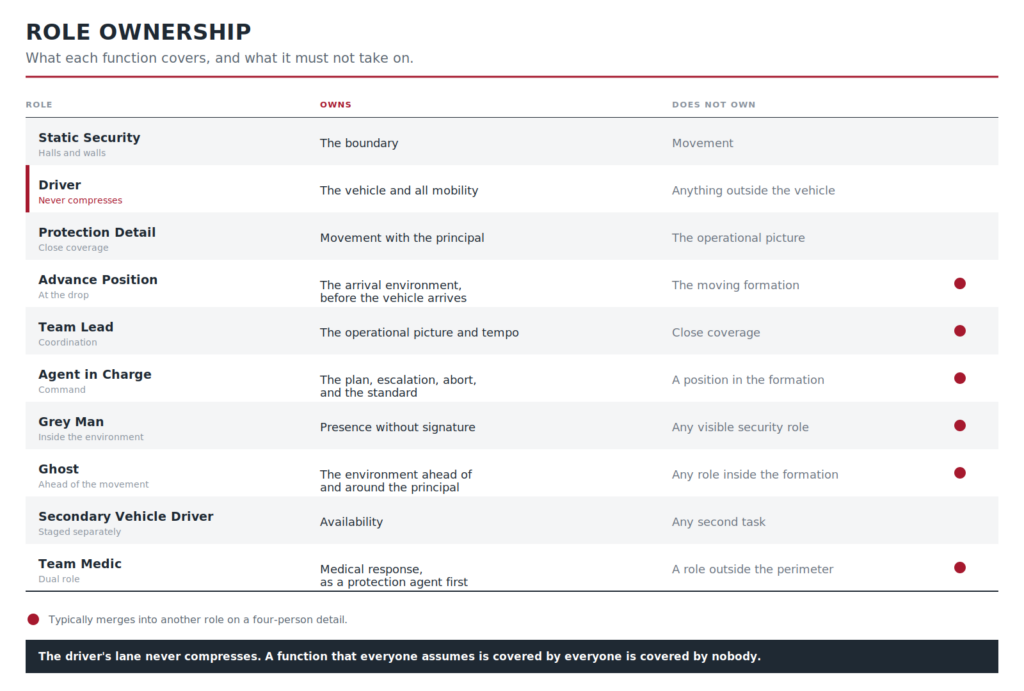
Static Security — Halls and Walls
Owns: the boundary. Fixed posts at doors, corridors, elevator banks, stairwells, and the perimeter of the principal’s operating space.
Does not own: movement. A static post that leaves its position to follow something has vacated the boundary it exists to hold.
Post placement comes directly from Stage 2 — the choke points, the thresholds, the transitions from controlled to uncontrolled space. Assigned properly, static security means the moving detail deals with far fewer problems, because most of them never reach the principal’s space.
This is also where nearly every practitioner in this profession starts, and where the fundamentals are learned: post discipline, observation without motion, the patience to stand somewhere for four hours and be genuinely alert at hour three.
The mistake teams make is treating static posts as the assignment that gets the least capable people and the least attention in the brief. A poorly placed or poorly briefed static post is not neutral. It is a gap with a person standing in it — and it reads to everyone else as coverage.
The Driver
Owns: the vehicle and everything that depends on it. Positioning, route execution, timing, the decision to move, evacuation initiation.
Does not own: anything else. At all.
This is the most frequently violated ownership line in this profession, and it almost always gets violated with good intentions. A driver leaves the vehicle to help with a door, carry something, or handle a client request. For as long as they are gone, the operation has no mobility. I have watched it happen on small details more than once, and the pattern is always the same — someone was trying to be helpful, and the vehicle sat empty at the one moment it needed to move.
The driver’s preparation happens in Stage 2 and is their own: driving every route personally, at the hour the movement occurs, in the vehicle that will be used. Knowing where the alternate diverges without looking. Knowing the hospital route from every point on the itinerary. Knowing which turns are blocked at certain hours and which structures have clearances their vehicle cannot pass.
A driver who has only seen the route on a map has not prepared.
The Vehicle Standard
The driver also owns something most protection training never addresses: the vehicle is a client-facing environment, and the standards governing it are part of the service rather than separate from it.
Many principals require the vehicle to remain running whenever they are on site. The reasoning is operational — an immediate departure cannot wait on an ignition, a cold engine, or a climate system that needs ninety seconds to become tolerable. It is also comfort. A principal stepping out of a venue in August in Florida should be stepping into a cooled vehicle, not one that has been closed in a parking lot for three hours. That standard is one more reason the driver does not leave. A running unattended vehicle is a liability; a running vehicle with a driver in it is a capability.
Beyond that, the details that look cosmetic are not:
No scent. No air fresheners, no cologne, no aftershave, no smoke residue, no food odor. A driver wearing cologne in a closed vehicle has imposed it on the principal for the length of the movement, and some principals have sensitivities they will never mention — they will simply request a different driver.
Climate set before arrival, not on arrival. The principal should never have to ask.
Beverages to the client’s standard. Bottled water at minimum, preference confirmed in advance and consistent at every movement. Clients notice this immediately when it is missing and rarely comment when it is right.
Interior clean at the start of every movement, not at the start of the day. Nothing left from the previous leg.
Exterior clean and wiped down — handles, glass, body panels. This is not vanity. At the upper tiers of this work, the principal is photographed getting out of that vehicle, and the image of them stepping out of a dirty SUV is a client image problem your team created.
None of this makes the principal physically safer. All of it determines whether the client experiences the detail as professional or as an imposition — and a client who is comfortable with their protection team is a client who cooperates with it. Cooperation is a security outcome. The practitioner who treats the service layer as beneath them tends to be the one whose recommendations get overruled when they matter.
The Protection Detail
Owns: close coverage. Movement with the principal, formation discipline, immediate physical response.
Does not own: the operational picture. This layer acts on information; it does not assemble it.
This is the most visible layer and, in most teams, the most overstaffed relative to what it actually covers. Bodies close to the principal do not multiply protection. Past a certain point, they reduce mobility, increase footprint, and produce a visible security posture that becomes its own exposure.
What this layer requires is not headcount. It is formation discipline, awareness of the geography being moved through — the choke points identified in Stage 2 — and the ability to receive information from every other layer in real time and act on it without breaking stride. Everything the static posts see, the ghost reports, and the advance position observes converges here and becomes movement decisions.
The Advance Position at the Drop
Owns: the arrival environment, before the vehicle arrives.
Stage 2 answered the drop question for the conditions that existed the day you walked it. The drop happens under whatever conditions exist that night, and something is always different — a delivery truck, an unscheduled crowd, three photographers who were not there yesterday.
That gap gets closed by someone having eyes on the drop ahead of the movement. On details with the manpower, that is a dedicated advance agent positioned at the arrival point, observing the curb, watching who is standing where and why, and receiving the principal when the vehicle stops. They are not part of the moving detail.
Not every detail has that. Budget, team size, and client tolerance for footprint are real, and pretending otherwise does not help the practitioner working with four people instead of ten. But the function does not disappear because the manpower does — it gets assigned to someone already on site. If team members are inside conducting setup, one steps out to cover the arrival window. If a grey man is working the environment, the drop is where they are ten minutes before the vehicle arrives.
The position matters more than the headcount. What that person reports is what shapes the arrival: is the curb clear, how many people are outside and who are they, is there media and is it credentialed, has anything changed, is anyone there who does not fit.
That report reaches the team lead before the vehicle makes its final approach — not as the doors are opening. Which gives the team lead a decision window: proceed, divert to the secondary, hold ninety seconds for a crowd to clear, or adjust the formation for a press presence nobody planned for.
Without it, the first person to assess the arrival environment is the principal, standing in it.
The Team Lead
Owns: the operational picture and the tempo. Where people are, what has changed, what the next movement requires, whether the plan still fits conditions.
Does not own: close coverage. You cannot hold a complete operational picture while your attention is eighteen inches from the principal.
Information moves up and down through this role. When the advance position reports a crowd at the drop, the team lead makes the call. When a post reports something anomalous, the team lead decides whether it reaches the principal’s movement or gets handled quietly.
On details large enough to have a dedicated team lead, keep them out of the formation. A team lead inside the formation is a team lead who has traded the picture for proximity, and the picture is the thing nobody else is holding.
The Agent in Charge
Owns: the plan, the client relationship, escalation, abort, and the standard.
That last one is the least tangible and the most consequential. What gets tolerated on a detail is set by whoever is in charge. Sloppy comms, late posts, unbriefed changes, assumptions that go unchallenged — every one of those is a decision the AIC made by not correcting it.
On a large detail, the AIC is not in the formation at all. They are positioned where they can see the operation rather than a corner of it.
The Grey Man
Owns: presence without signature. Observation from inside the environment rather than around it.
The grey man is not hiding and is not undercover. They are simply not identifiable as part of the detail — moving through the environment as someone who belongs in it while observing what a visibly postured agent cannot.
The value is twofold. People behave differently around visible security; someone conducting surveillance adjusts around a detail they have identified and does not adjust around someone they have not. And the grey man occupies space the visible detail cannot — the crowd, the bar, the lobby, the area outside the perimeter where visible presence would be conspicuous or unwelcome.
This is one of the hardest roles to execute, and it is routinely assigned to people who cannot do it. Blending is not about clothing. It is about behavior — the pace you move at, where your eyes go, whether you touch your ear, whether you stand when everyone else is sitting. A practitioner in a suit scanning a room with their hands crossed is not a grey man in plain clothes. They are a security officer in different clothing, and the room knows it.
Experience is the qualifier here, not equipment.
The Ghost
Owns: the environment ahead of and around the principal, while the operation is live.
A single team member, in plain clothes, works the route before the principal travels it, the venue before the principal enters it, and the surrounding area while the principal is inside. They are not part of the visible detail and do not join it.
They are looking for what Stage 2 could not predict — the vehicle parked with someone in it for two hours, the person who has appeared at three separate locations on the itinerary, equipment that does not belong, the door propped open now that was not yesterday.
Functionally, the ghost is Stage 2 continuing once the operation is live. Everything Stages 1 and 2 established was true when it was established. The ghost keeps it true.
They report to the AIC or team lead, not to the formation, and they report continuously rather than only on anomalies. Absence of a report is not information — it means either nothing has happened or something has happened to the person who would have told you. A ghost who has seen nothing for twenty minutes still says so.
The counter-surveillance fundamentals underlying this role — the pre-attack surveillance cycle, detection methodology, and behavioral indicators — are covered in depth in Advanced Force Multipliers, EP Wired, June 2026.
The Secondary Vehicle Driver
Owns: availability. One function, and nothing else attached to it.
Stage 2 fixed the position. This role holds it. Engine cold or running depending on environment and threat picture, but the driver does not leave the vehicle and does not take on any other task.
The secondary vehicle’s entire purpose is to be available in the ninety seconds when nothing else is. A driver who stepped away to help with something has removed the only thing that asset was there to provide — and unlike the primary, nobody notices until it is needed.
The temptation is to upgrade it. Better vehicle, more capability, closer position. Every one of those trades away the thing that makes it work.
The Team Medic
Owns: medical response, as a protection agent first.
This is a deliberate structure rather than a convenience. A standalone medic with no protection training is a liability in an active threat environment — their focus goes to the patient at the moment the threat may still be present, and they contribute nothing to security while they work. A protection agent with medical training maintains posture while initiating care. They are not a hole in the perimeter treating the principal. They are part of the perimeter, treating.
Response time is the variable that determines outcome. Emergency medical services, measured in minutes, are the difference between a survivable event and a fatality in cardiac arrest, airway compromise, or hemorrhage. Capability organic to the detail closes that gap. Capability on call does not.
This role’s preparation comes out of Stage 2 and belongs in the record: nearest trauma center and its designation, route from every point on the itinerary, secondary facility, whether air transport is available and where it can land, on-site medical resources, and the rally point marked on the top-down.
FIELD NOTE — TCCC, TECC, and the Standard That Applies to You
Tactical Combat Casualty Care (TCCC) is the U.S. military standard for prehospital trauma care where the threat is not yet resolved. It is maintained by the Committee on Tactical Combat Casualty Care, the prehospital arm of the Joint Trauma System for the Department of Defense, and combat medical personnel and non-medical combatants across the U.S. and most coalition militaries train to its guidelines.
TECC is the civilian adaptation. Tactical Emergency Casualty Care translates the same principles into civilian high-threat environments — active shooter events, terrorism, mass casualty incidents — and is maintained by the Committee for Tactical Emergency Casualty Care. It is used by law enforcement, civilian EMS, and first responders. For a private protective detail operating under civilian legal and equipment constraints, that is the framework built for the conditions you are working in. Confirm the certification requirements your jurisdiction, your insurer, and your client actually impose before treating any single credential as sufficient.
Why the framework matters. Conventional medical training assumes a secure scene. Protective operations frequently do not have one. The phased structure — care under fire, tactical field care, evacuation care — matches how a protection incident actually unfolds.
What it prioritizes. Massive hemorrhage control, airway, respiration, circulation, hypothermia prevention — in that order, because that order reflects what kills people in the first minutes. The framework exists because analysis of Vietnam-era combat deaths established that a large share of fatalities occurred before casualties reached a surgeon, from conditions treatable in the field.
The equipment follows the training. A tourniquet, chest seal, and airway adjunct in the hands of someone who has never trained under stress is decoration. The certification is the asset. The kit is what it operates.
Standards and current guidelines: Joint Trauma System (jts.health.mil) for TCCC; C-TECC for TECC. Verify current curricula and certification requirements before relying on any of the above.
THE STANDARD: Every function above has a named owner before deployment, and every owner can state what they do not own. Functions that go unassigned are not covered by good intentions — they are covered by nobody, and the discovery happens at the worst possible time.
STAGE 4 — BUILDING SMALL: WHAT MERGES AND WHAT NEVER DOES
An unstaffed function is a decision. An unassigned function is an accident. Only one of them can be planned around.
Most details do not have eleven people. Budget, client tolerance for footprint, and the practical reality of the work mean many protective operations in this industry run with four, three, or two.
That does not change which functions have to be covered. It changes who covers them — and it makes the assignment more important, not less. A large detail can absorb a role that nobody explicitly owns, because someone will usually notice. A four-person detail has no absorption capacity. Every gap is load-bearing.
The Merges
On a four-person detail, the AIC and team lead functions collapse into one person. That is workable, and it is the most common configuration in this profession.
The advance position at the drop gets absorbed by whoever arrives first and can step outside during the arrival window. The grey man and the ghost frequently become the same person, working the environment ahead of and around the movement rather than holding both roles simultaneously. The team medic is one of the close coverage agents rather than a dedicated position.
None of that is a compromise. It is how competent small teams operate.
The Lines That Do Not Move
The driver still drives, and only drives. This one does not compress at any team size. I state that without qualification deliberately. Practitioners will name exceptions, and some of them are real — but I would rather a reader argue with an absolute than absorb a hedge and quietly let the driver step out of the vehicle.
Nobody holds the operational picture while standing on the principal. When the AIC and team lead functions merge, that combined role stays out of the formation. If the merged role is also close coverage, the picture is not being held by anyone, and the detail is operating blind at exactly the moments it is most compressed.
The secondary vehicle driver, if you have one, holds only that. The value of the asset is availability. A secondary driver with a second job has an asset that is available except when it isn’t, which is not an asset.
Say It Out Loud, and Write It Down
The merge has to be deliberate. Named in the brief, written into the record, acknowledged by the person carrying it.
“You have the advance position at the drop, and you’re back inside for the movement” is an assignment. Silence is not. A function that everyone assumes is covered by everyone is covered by nobody, and the discovery happens under pressure with no time to correct it.
Tell the Client What the Footprint Does Not Cover
This is the part most agencies skip, and it belongs in Stage 5’s paperwork as much as it belongs here.
When the team size genuinely cannot cover a function — no ghost, no secondary vehicle, no dedicated medical capability — that is not a gap to be quietly absorbed and hoped past. It is an accepted risk, and the client is the one accepting it. Say so in writing, before the engagement starts.
Two things follow from that. The client makes an informed decision about whether to fund the function or accept its absence, which is their call to make and not yours. And when something happens in the space that function would have covered, the record shows a documented decision rather than an oversight.
An unstaffed function that the client knowingly declined is a business outcome. An unassigned function nobody named is a failure — and it is your failure, not theirs.
THE STANDARD: Every merge named, assigned to a person, and recorded. The driver’s lane never compresses. Any function the footprint cannot cover is disclosed to the client in writing as an accepted risk before deployment — never absorbed silently.
STAGE 5 — THE RULES YOU BUILD IN: AUTHORITY, AGREEMENT, AND JURISDICTION
Authority is not something you establish when you need it. By then, whatever you have is whatever you brought.
Stages 1 through 4 built capability, constraint, and coverage. Stage 5 establishes what the team is permitted to do with all of it.
This is the stage most often skipped, and the skip is understandable — it is paperwork, it happens before anything interesting starts, and no client has ever been impressed by it. It is also the stage that determines what happens in the two seconds after something goes wrong, because in those two seconds a practitioner acts on whatever authority they believe they have.
Nothing in this section is legal advice, and it should not be read as a substitute for counsel. Requirements vary by state, by country, and by the circumstances of an engagement, and they change. What this stage establishes is that the questions get asked and answered before deployment, in writing, by someone qualified to answer them.
Three Sources of Authority, and the Most Restrictive Governs
The law. What force is legally justified, when, and by whom. Self-defense and defense-of-others statutes vary meaningfully between jurisdictions. So do the rules governing detention, the point at which physical contact becomes an assault, and whether a private citizen has any authority to hold someone at all. A response that is lawful in one state may generate a criminal charge two states away on the identical set of facts.
Your license. Security and investigative licensing is state-regulated, and licenses do not travel. An armed license in one state does not authorize armed work in another. Firearms carry authority is a separate question from security licensing authority, and satisfying one does not satisfy the other. Working across a state line without confirming the licensing position is a regulatory exposure that lands on the agency, not just the individual.
The client agreement. What the client has contracted for, what they have authorized, and what they have explicitly declined. A client who will not accept an armed detail has set a rule of engagement. A client who wants no visible security presence has set another. These are legitimate decisions that constrain the operation — which is exactly why they belong here rather than surfacing as a surprise on movement day.
Where the three conflict, the most restrictive governs. A practitioner who does not know which is most restrictive in the jurisdiction they are standing in is operating on assumption.
The Conversation Nobody Schedules
The most valuable work in this stage happens in a conversation with the client about what your team will and will not do.
Clients frequently hold assumptions about protective capability that come from film rather than from the profession. Some assume the team has authority it does not have — to detain, to clear people from a public space, to seize a phone or a camera, to compel someone to leave. Others assume the opposite and are surprised the team will physically intervene at all.
Both assumptions cause a problem at the same moment: when something happens, and the client expects an action the team is not authorized to take.
So it gets settled here. What the team does when someone approaches. What happens when a person refuses to move. The response to a photographer, a fixated individual, an intoxicated attendee, an aggrieved former employee, a journalist with a question the client does not want asked. Where the line sits between your authority and law enforcement’s — and the fact that on the far side of that line, summoning law enforcement is the correct action rather than a failure of the team.
Protection the principal will not accept is not a plan. This is where that gets established rather than discovered.
It Goes in the Service Agreement, Not Just the Brief
This is the level most of this industry skips, and it is the one that matters when something goes wrong.
The contract is where the scope of the protective function is defined in writing and agreed by both parties — before anyone deploys, before a retainer is paid, before a client forms an expectation the team cannot lawfully meet.
That means the agreement addresses scenarios, not just services. What the team does when an unauthorized person approaches the principal. What happens when someone refuses a lawful instruction to leave a private space. How the team responds to media and photographers, including on public property where they have every right to be. What happens with an intoxicated or aggressive individual. What happens with a fixated person who has made no threat. Whether the detail is armed and under what licensing authority. What triggers an abort and who holds that authority. And what the team will not do under any circumstances, named explicitly.
That last one is the most valuable clause in the document. A client who has signed an agreement stating that the team does not detain, does not seize property, does not use force outside lawful self-defense and defense of others, and does not substitute for law enforcement cannot credibly claim afterward that they expected otherwise. It protects the client from an unrealistic expectation and the agency from a claim built on one.
The nuances belong there too. A principal who does not want to be touched. A family member with different authority than the principal. A residence with different rules than a public appearance. A minor on the detail with an entirely different protective standard. Every one of those is a rule of engagement, and every one causes a problem if the first time it is discussed is the moment it applies.
And this is where Stage 4’s disclosure lands. Any function the footprint cannot cover — no ghost, no secondary vehicle, no dedicated medical capability — is documented here as an accepted risk, acknowledged by the party accepting it.
The Lawful Conduct Clause
There is one clause that belongs in every protective services agreement and appears in very few of them: an explicit statement that the team will not perform unlawful acts, regardless of who requests them.
This is not a hypothetical protection. Clients occasionally ask protection teams to do things outside a lawful protective scope, and they usually do not experience the request as improper. Follow a spouse. Access someone’s records or accounts. Retrieve property from a residence the client no longer has access to. Obtain information about a business rival. Transport something the team has not been permitted to inspect. Position the detail to prevent a person from leaving. Each of those requests has been made of practitioners in this industry, and each is a different offense depending on jurisdiction.
The agreement should state plainly that the agency operates within the law, that team members will decline any instruction requiring an unlawful act, and that declining such an instruction is not a breach of the agreement.
That single clause does three things at once. It sets the client’s expectation before the relationship starts. It gives the practitioner on the ground a documented basis for saying no — not a personal refusal, a contractual one, which is a very different conversation to have at eleven at night with a client who is insisting. And it protects the agency from a client who later characterizes the refusal as non-performance.
The clause cuts in the other direction as well. The agreement should establish the standard of conduct the agency holds its own personnel to — lawful conduct, licensing compliance, no unauthorized recording or disclosure of client information, no use of the engagement for personal benefit, and the consequence for violating any of it. A team member who acts unlawfully on a detail exposes the client, the agency, and every other practitioner on that team.
What the agreement should address: scope of the protective function and its limits; whether the detail is armed, under what licensing authority, and in which jurisdictions; use-of-force limited to lawful self-defense and defense of others; that the team does not detain, seize property, or substitute for law enforcement; when law enforcement is summoned and by whom; abort authority and its triggers; confidentiality and non-disclosure in both directions; insurance, indemnification, and liability allocation; licensing compliance and its geographic limits; the lawful conduct clause, both ways; client-specific rules of engagement; accepted-risk disclosure for uncovered functions; and what happens if the client instructs the team outside the agreed scope.
Have counsel draft and review it. I am a practitioner, not an attorney, and protective services agreements sit at an intersection of contract law, licensing regulation, employment law, and liability exposure that varies by state. What I can tell you from the operational side is which failures produce claims — and nearly all of them trace back to an expectation that was never written down.
Then It Gets Briefed
Contracted authority that lives in a signed document nobody has read is not authority the team can act on.
Every team member should be able to state, without hesitation, what they are authorized to do, what triggers a response, who has authority to escalate, when law enforcement is called and by whom, and what the abort criteria are.
Real-time judgment has its place, and a good practitioner makes dozens of judgment calls on every detail. But the boundaries of that judgment are not something to work out while a situation develops. They are established in a signed agreement, translated into the operational record, and briefed before anyone moves.
An agency that settles its rules of engagement in the moment has not settled them. It has delegated them to whoever is standing closest to the problem, under pressure, with nothing behind the decision.
Crossing a Border Changes the Operation, Not Just the Location
The moment an operation leaves the country, most of what the team relies on domestically stops applying — and the change is structural rather than procedural.
Licensing does not transfer. Firearms authority almost never transfers, and moving a weapon internationally without host-nation authorization is a serious criminal exposure in most of the world, including countries that are otherwise close allies. Your legal standing to use force changes. Your relationship with local law enforcement changes from partner to foreign national requesting assistance. The insurance and liability position changes. Even your ability to communicate on your usual platforms may be restricted or monitored.
What most teams do not internalize is that the role itself changes. In a great many international environments, the correct structure is a licensed local provider executing the physical protection function under the coordination of the visiting team — with the visiting practitioner operating in an advisory, planning, and continuity capacity rather than as the armed close-coverage element.
That is not a demotion. It is the only structure that is both lawful and effective, because the local provider has the licensing, the language, the relationships, and the environmental knowledge that no amount of preparation replicates in seventy-two hours.
Selecting and vetting that provider belongs to this stage, and it is one of the highest-consequence decisions in an international operation.
Cultural and Religious Protocol Is Operational
This gets treated as etiquette. It is not. It is threat mitigation.
Local religious and cultural norms determine how your team’s presence is interpreted — and misreading them produces the exact outcome protection exists to prevent: unwanted attention, offense that escalates, a crowd that turns from indifferent to hostile, and a principal who becomes the story.
The dimensions that affect the operation directly: appropriate dress for the team and guidance for the principal, particularly at religious sites; observance days and prayer times that change traffic, business hours, venue access, and staffing; norms governing physical contact, which affect formation and any hands-on intervention; whether a female team member is required or prohibited for certain interactions; photography restrictions at sites and around people; local sensitivities around specific topics, gestures, and symbols; and protocol for interacting with officials, clergy, and security personnel.
A team that gets this wrong creates a security incident out of a non-event.
The international operating environment carries enough distinct doctrine — jurisdiction, provider vetting, host-nation coordination, travel security, evacuation planning across borders — that what appears here is a constraint list rather than a treatment of it. Every item above is a question to resolve before travel, with counsel and with host-nation authority, and none of them resolve from a domestic assumption.
FIELD NOTE — What Changes at a Border
Licensing. Domestic security and armed licensure do not transfer internationally. Assume no authority until it is confirmed in writing by host-nation authority or a licensed local provider.
Weapons. Carriage authority is host-nation controlled. In most countries, a visiting private protection team is unarmed, and unauthorized transport of a weapon is a serious criminal offense. Resolved before travel through the proper channel, or the answer is no.
Force authority. Self-defense and defense-of-others standards differ by country, sometimes substantially. What is a justified response domestically may be a prosecutable act abroad.
Law enforcement relationship. You are a foreign national requesting assistance, not a domestic partner with an established liaison. Establish the actual point of contact in advance.
The local provider is the physical element. Licensed, vetted, and contracted in advance. The visiting team coordinates, plans, and maintains continuity with the principal.
Medical and evacuation. Facility standards vary widely. Confirm the receiving facility, the medical evacuation provider, insurance that actually applies abroad, and the route to a location capable of the required level of care.
Documentation and diplomatic contact. Passport and visa status for every team member, the nearest embassy or consulate and its contact, and a communications plan that functions on local infrastructure.
Verify per country, per trip, per team member — with counsel and host-nation authority. Last year’s answer is not this year’s answer.
THE STANDARD: Rules of engagement documented in the signed service agreement, not just the brief. The lawful conduct clause in both directions. Uncovered functions disclosed as accepted risk. Every team member able to state their authority without hesitation. Jurisdiction, licensing, and carriage confirmed in writing for every location on the itinerary.
STAGE 6 — THE LAST CHECK: TESTING IT BEFORE IT CARRIES WEIGHT
An operation that has never been tested is an assumption with people standing in it.
Five stages produced an operation. This stage answers one question: does it actually work, right now, under the conditions that exist rather than the ones you planned for?
Most teams never ask it. The principal is ready, the vehicle is staged, the schedule says now, and the detail moves because that is what the schedule said. That is not a check. That is a departure time.
What Has to Be Confirmed
Confirmed means verified within a defined window before movement — not assumed, not probably fine.
The team is in position and has said so individually. “Everyone set?” answered by silence is not confirmation; every post reports its own status.
Communications are tested across every channel and every device, with the person who tested them saying so.
The route is currently clear, confirmed by someone who looked at it in the last few minutes — not the walk from three days ago.
The arrival environment is known, reported by whoever has eyes on it, with conditions described rather than characterized.
The vehicles are staged, occupied, and ready — primary and secondary.
The receiving end is prepared, and whoever controls the destination knows the movement is inbound.
Nothing material has changed since the brief, which means someone has to have been checking.
If any of that cannot be confirmed, the answer is not yet. Not no — not yet. That distinction matters more than it looks, because a practitioner who thinks holding means canceling will proceed rather than hold. Most of the time the hold is ninety seconds while a crowd clears or a channel gets fixed. Ninety seconds is available right up until the moment it isn’t.
Contingencies Get an Owner, Not Just a Plan
The check presumes the plan works. Contingency planning is the acknowledgment that it frequently will not, and it is where a serious operation separates from a confident one.
Every contingency has the same three parts: a condition, a response, and an owner.
If the primary drop is blocked, divert to the secondary — the driver executes, the team lead calls it. If the primary route is obstructed, take the alternate — decided by the driver in motion, reported to the team lead. If the alternate egress is locked, go to the hard point identified on the top-down. If the principal cannot be moved out, hold at the designated room until the environment resolves. If a medical event occurs, the team medic initiates, the driver stages, and the team lead notifies the receiving facility. If communications fail, fall back to the secondary platform; if that fails, the pre-agreed rally point governs.
None of that is improvisation. It is a set of decisions made in a quiet room and rehearsed in the brief, so that under pressure the team executes something it has already agreed to rather than negotiating in real time.
The test of a contingency plan is whether a team member can state, without looking anything up, what they personally do when a given condition occurs. If they have to think about it, it was written but not briefed.
One Person Decides
Contingencies fail more often because nobody was clearly empowered to choose than because the wrong option was chosen.
Authority has to be explicit and singular. The agent in charge owns the go, the hold, and the abort. In their absence, a named individual holds it — named, not implied by seniority. Movement decisions in motion belong to the driver, because they are the only person with the information and the control to execute them. Formation and immediate close-coverage decisions belong to whoever is on the principal, because there is no time to route them anywhere.
Everything else escalates.
The failure mode is a team where three capable people each believe they might have authority. Under pressure that produces either paralysis or two simultaneous conflicting actions, and both are worse than a mediocre decision made cleanly by one person.
Abort authority deserves its own line in the brief. Someone must be able to say the movement is not happening, and everyone must know who that is before it is needed. A team where nobody explicitly holds it will always proceed, because proceeding requires no one to take responsibility for stopping.
Who Verifies a Call
This is the part almost nobody plans, and it is where good teams come apart.
A team member sees something and puts it over comms. Someone in a crowd. A vehicle that does not belong. A person moving toward the principal. The call is made in three seconds, with partial information, by someone whose adrenaline just spiked.
Now what?
React to every call at full escalation and the operation gets moved by noise — and anyone who understands that can generate a diversion cheaply. Ignore calls, and the one that mattered gets ignored with the rest. Neither is acceptable, which means the operation needs a verification step with a named owner.
The structure that works is simple. The reporting member states what they observe — what they actually see, in plain language, with location. Not their conclusion. “Male, dark jacket, moving toward the north entrance, closing” is a report. “We have a problem at the north entrance” is a conclusion that has already made a decision for everyone listening.
The team lead is the verification point. They either have eyes on it themselves, direct the nearest available element to confirm, or task the ghost — who is not tied to the formation and can move without altering the detail’s posture. Confirmation comes back before a response is authorized.
The exception has to be stated explicitly, in the brief, out loud: any team member may act immediately, without verification, on an immediate threat to the principal. Verification is for ambiguity. It is not a permission structure that delays a response to something already happening. Every practitioner on that detail should be able to articulate the distinction, because the moment someone hesitates on the wrong side of it, the structure has caused harm rather than prevented it.
And when a call turns out to be nothing — which it will, most of the time — that gets acknowledged on the channel and it does not get treated as an error. A team that gets criticized for reporting learns to stop reporting. The false positive is the price of the true one, and the price is acceptable.
The Willingness to Hold
The hardest part of this stage is not knowing the criteria. It is enforcing them when a client is waiting, a schedule is slipping, and a room full of people is expecting the principal.
That pressure is real, and it is where the whole sequence most often gets overridden. The practitioner who knows the alternate egress is locked and says nothing — because they do not want to be the reason the movement is late — has traded a ninety-second delay for an unmitigated risk, and has done it silently, so nobody else got to weigh the decision.
Everything in Stages 1 through 5 exists to give the team standing to say not yet. Every question answered in advance is a documented, defensible basis for holding. Without it, holding is an opinion. With it, holding is a finding.
That is what the sequence ultimately produces. Not a folder. Not a map. The standing to make a decision under pressure and be right.
THE STANDARD: Every condition confirmed individually within a defined window. Every contingency carries a condition, a response, and a named owner. One person holds go, hold, and abort. A verification owner is named — with the immediate-threat exception stated out loud in the brief.
WHAT THE SEQUENCE ACTUALLY GIVES YOU
Six stages. Assets, ground, team, small-team assignment, rules, and the check.
The sequence is not stylistic. Each stage produces something the next one requires, and skipping one does not remove the requirement — it just moves the decision to a worse moment, made by a person with less information and less time.
What you end up with is not a bigger detail. Most of the operations described here run with four people. What you end up with is a detail where every function has a name attached to it, every constraint was discovered on a walk rather than during a movement, every authority was established in writing before anyone needed to rely on it, and every person can state what they own and what they do not.
That is an assembled detail. And an assembled detail is the thing you can hand to someone else.
That distinction is worth sitting with, because this profession is not short on people who can perform the work and is very short on people who can transmit it. I learned this in the field from practitioners who had no obligation to teach me anything and taught me everything anyway — how the sequence runs, why the order matters, what breaks when you skip a stage. None of them protected their knowledge. That is the reason any of this is writable.
So work it in order. Assign every function, out loud, to a person. Disclose what you cannot cover. Test it before it carries weight. And when someone newer than you is ready to learn how it goes together, hold nothing back.
A checklist can be handed over. Knowing how it goes together has to be taught.
FREQUENTLY ASKED QUESTIONS
How many people does an executive protection detail actually need?
There is no fixed number, and headcount is the wrong starting question. What matters is which functions have to be covered for that principal, in that environment, and whether each one has a named owner. Many protective operations in this industry run with four people or fewer. A four-person detail that has deliberately assigned every function will outperform an eight-person detail where three people are covering the same door, and nobody owns the arrival environment.
What is the difference between a grey man and a ghost on a protective detail?
Both work in plain clothes and neither is identifiable as part of the detail, but they own different things. The grey man is present inside the environment the principal is in — the crowd, the lobby, the room — observing what a visibly postured agent cannot. The ghost works ahead of and around the movement: the route before the principal travels it, the venue before the principal enters it, and the surrounding area while the principal is inside. The grey man is inside the event. The ghost is outside it, moving.
What should a protective services agreement include?
Beyond commercial terms, it should define the scope of the protective function and its limits; whether the detail is armed and under what licensing authority; use-of-force limited to lawful self-defense and defense of others; explicit statements that the team does not detain, seize property, or substitute for law enforcement; when law enforcement is summoned and by whom; abort authority and its triggers; confidentiality in both directions; insurance and liability allocation; client-specific rules of engagement; disclosure of any function the agreed footprint cannot cover; and a lawful conduct clause. Have counsel draft it.
Can a private protection team detain someone?
That depends entirely on jurisdiction, and in many places the answer is no or is far narrower than practitioners assume. The rules governing detention, the point at which physical contact becomes an assault, and whether a private citizen has any authority to hold someone vary meaningfully between states and change entirely across borders. This is a question to resolve with counsel for each jurisdiction you operate in, and to state explicitly in the service agreement so the client’s expectations match the team’s actual authority.
What changes when an executive protection team works internationally?
Structurally, almost everything. Domestic licensing does not transfer. Firearms authority almost never transfers. Your legal standing to use force changes. Your relationship with law enforcement shifts from partner to foreign national requesting assistance. In many international environments, the correct structure is a licensed local provider executing the physical protection function, with the visiting team coordinating, planning, and maintaining continuity with the principal. Selecting and vetting that provider is one of the highest-consequence decisions in an international operation.
What is the difference between TCCC and TECC?
Tactical Combat Casualty Care is the U.S. military standard for prehospital trauma care where the threat is not yet resolved, maintained by the Committee on Tactical Combat Casualty Care under the Joint Trauma System. Tactical Emergency Casualty Care is the civilian adaptation of the same principles for high-threat civilian environments, maintained by the Committee for Tactical Emergency Casualty Care and used by law enforcement, civilian EMS, and first responders. For a private protective detail operating under civilian legal and equipment constraints, TECC is the framework built for those conditions — though certification requirements vary by jurisdiction, insurer, and client, and should be confirmed directly.
What is a green light in protective operations?
It is the decision point where preparation becomes an operation — the confirmation that specific conditions have been verified within a defined window before the principal moves. Team in position and individually confirmed, communications tested, route currently clear, arrival environment reported, vehicles staged and occupied, receiving end prepared, nothing material changed since the brief. If any condition cannot be confirmed, the answer is not yet. One named person holds go, hold, and abort authority.
ABOUT THE AUTHOR

Nic Moretto, SAS-AP® | Founder & CEO, TESS GLOBAL | Tactful Elite Security Solutions | Merritt Island, Florida
Nic Moretto, SAS-AP® is the Founder & CEO of TESS GLOBAL | Tactful Elite Security Solutions, a BBB A+ Accredited, Florida-licensed security agency headquartered on Florida’s Space Coast, operating since 2014 and recognized as a Top 3 Space Coast Security Guard Service in both 2025 and 2026. TESS Global specializes in Intelligence-Led Security, Security Program Development, and COOP Security Support for high-consequence environments.
With over twenty-two years of experience across executive protection, armed security, and security program development, Nic holds multiple Florida state licenses, including Class B, C, D, DI, and G, and carries the Situational Awareness Advanced Practitioner (SAS-AP®) designation through the Arcuri Group. He has built a reputation for proactive, intelligence-driven security across Florida’s Space Coast and Central Florida region.
A monthly contributing author to EP Wired and an active voice in operational preparedness and modern security program development, Nic is the author of Situational Awareness at Scale (EP Wired, May 2026) and Advanced Force Multipliers (EP Wired, June 2026).
LinkedIn: https://www.linkedin.com/in/nic-moretto-sas-ap/
Tess Global | Tactful Elite Security Solutions