



This weekend, an individual, described by authorities as mentally unstable, attempted to breach the Secret Service security perimeter during the White House Correspondents’ Dinner in Washington, DC, one of the most tightly controlled and high-visibility protective events in the United States.
In the immediate aftermath of incidents like this, a familiar pattern emerges. Public and industry discourse quickly fills with speculation, commentary, and reaction, much of it driven less by fact and more by assumption or political bias. Social media platforms, in particular, become saturated with confident assertions from individuals lacking direct knowledge of protective operations, threat assessment protocols, or the realities of federal security planning.
Within the executive protection and security community, there is also a recurring misstep. Some professionals attempt to leverage these moments for visibility or “brand building,” offering rapid analysis that often amounts to little more than conjecture. In the absence of verified details, these personal takes frequently miss the mark, oversimplifying complex protective measures or mischaracterizing the nature of the threat.
The reality is that incidents involving protective perimeters, especially those managed by agencies such as the United States Secret Service, are rarely as straightforward as they appear from the outside. Complex planning, intelligence integration, and contingency response are deliberately designed to absorb and neutralize unpredictable behavior, including actions by armed individuals.
Moments like these should serve as reminders of the complexity inherent in protective operations, not as opportunities for uninformed commentary. Thoughtful analysis requires patience, education, verified information, and an understanding of the operational environment, qualities that are often in short supply in the immediate aftermath of high-profile security incidents.
About a month ago, a popular industry intelligence report, one grounded in verified data analytics, was released and widely quoted across the Executive Protection (EP) sector. Similar to this weekend’s incident, the data from the report was misunderstood and selectively interpreted, repackaged, and in some cases, outright distorted in sales pitches for services, marketing campaigns, and subsequent presentations.
I’m aware that some sectors of this field rely on doom and gloom to generate sales, but key metrics from this report were repeated out of context, and trend lines were greatly exaggerated. The factual findings were reduced to alarmist talking points designed to justify expanded service offerings, training sales, and inflated risk.
The underlying data clearly did not support the narrative being pushed by some. It reflected complex, evolving risk patterns, not a runaway escalation of threat. But complexity doesn’t sell… urgency and fear do. So, for some, the message was simplified, sharpened, and ultimately skewed to fit a more compelling and profitable storyline.
That should concern anyone serious about this profession. When data is used as weaponized marketing rather than an operational tool, it undermines credibility and distorts decision-making at every level, from practitioners to corporate boards. So, before we drift too far into more fear-driven conclusions, which, lately, seems to be less of an exception and more of the norm, we need to reestablish a baseline grounded in reality:
The sky isn’t falling.
Despite what headlines, social media, news coverage, and industry marketing cycles may suggest, crime in the United States has broadly declined in recent years, according to data published by the Federal Bureau of Investigation (FBI). The FBI’s Uniform Crime Reporting (UCR) and more recent Crime Data Explorer releases show notable decreases in violent crime, including homicide, from 2022 through 2024. In fact, 2023–2024 saw one of the largest single-year drops in homicides in modern U.S. history. And yet, if you work in this field, it certainly doesn’t feel that way. That disconnect is the point.
The Chicken Little Problem: Perception vs. Reality
Like Chicken Little running through the village shouting that the sky is falling, today’s information environment amplifies visibility over validity. High-profile incidents involving executives are now instantaneously global due to market reach, replayed endlessly, framed for maximum engagement, and inevitably monetized on social media through attention bots and clicks.
The result is a growing public perception of escalating chaos, even as many verified crime metrics trend downward. This disconnect is not an argument that threats are diminishing; they are not. Rather, it highlights a shift in how threat perception is formed. Increasingly, it is shaped less by objective data and more by constant exposure to curated, amplified, and often sensationalized information streams.
This dynamic has second and third-order effects. Individuals already experiencing mental instability may internalize exaggerated narratives, interpreting political rhetoric or media-driven alarmism as validation of their worldview. In some cases, this can contribute to action, transforming perception into behavior and further complicating an already nuanced threat landscape.
At the same time, elements within the security and executive protection industry are not immune to these pressures. Heightened perception of risk can be leveraged, intentionally or not, to drive demand for expanded services, including training programs, intelligence platforms, and increased staffing models. While many of these resources are valuable and necessary, the risk lies in allowing perception, rather than validated need, to dictate decision-making.
A disciplined approach to threat assessment requires grounding in verified data, contextual analysis, and professional restraint. Without that foundation, both public understanding and industry practices risk being shaped by distortion rather than reality.
The Real Shift: Visibility, Not Volume
High-profile incidents have thrust executive protection (EP) into the mainstream spotlight, transforming what was once a “silent” service into a point of intense corporate scrutiny. With major outlets like the Wall Street Journal now analyzing the operational costs and business impacts of these programs, boards and shareholders are paying closer attention more than ever.
This shift in discourse highlights a new reality for modern protective programs:
- Visibility as a Line Item: EP is no longer a hidden cost but a highly visible business expenditure that is increasingly scrutinized by stakeholders. Quality matters.
- Market Sensitivity: Security failures are no longer viewed merely as operational lapses; they are clearly market events that can directly erode shareholder value and stock price.
- The Efficacy Gap: The narrative has shifted to acknowledge that EP programs are only truly effective if they are seamlessly integrated into corporate governance and supported by proactive, data-driven risk management rather than reactive optics.
Organizations, boards, and even the public now evaluate protective effectiveness in near real-time. So, while crime is statistically dropping, accountability is sharply increasing.
Expanding Threat Surface (Even in a Lower-Crime Environment)
For those operating within the executive protection space, the current operational truth is that risk has become increasingly personal rather than simply more prevalent. This shift has prompted executives and ultra-high-net-worth families to extend their protective umbrellas far beyond traditional corporate roles, integrating security directly into their private residences, personal travel, family environments, and digital ecosystems.
This is not because the world is collapsing; it’s because targeted threats have expanded. What used to be a workplace-focused protection model is now a lifestyle-integrated risk posture.
Media Amplification and the “Fear Market”
There is also the uncomfortable truth in the modern EP ecosystem: Fear sells (and it always will).
There is an old media adage. “If it bleeds, it leads (or reads),” and it has never been more applicable to the modern information environment. As media outlets compete for relevance, clicks, and market share, news coverage has become increasingly concentrated on high-visibility failures in security planning and execution, particularly when those failures involve recognizable names or institutions like the President of the United States. Other incidents like the assassination of United Healthcare CEO Brian Thompson, the murder of political commentator Charlie Kirk, the stalking concerns involving Tim Cook of Apple Inc., and the reported attack on Sam Altman of OpenAI are not just reported; they are amplified, dissected, and repackaged across multiple platforms in real time.
Each of these events becomes more than an isolated incident; it becomes a case study in perceived vulnerability and often a knee-jerk reactionary security buildup. Media narratives never dwell on the thousands of uneventful, successful protective operations conducted daily. Success doesn’t sell unless you’re an astronaut. Instead, they focus on the exception, the breach, the lapse, the moment where protection appears to have failed, or protectors use recorded violence. This creates a distorted but powerful feedback loop where rarely seen, high-impact incidents are elevated to represent the industry as a whole, shaping public perception and, increasingly, client expectations.
For EP professionals, the consequences are significant. These stories drive a “fear market” in which organizations and high-net-worth individuals feel compelled to expand security measures, not solely based on empirical threat data, but on highly visible examples of what happens when things go wrong. In this environment, perception becomes operational reality for the unknowing. Protective programs are no longer judged just on outcomes, but on whether they can withstand the scrutiny of a 24-hour media cycle that is actively searching for the next failure to spotlight.
To be clear, the incidents involving high-profile executives are serious and demand professional attention. But they are not statistically representative of a collapsing security environment.
Following the Thompson incident, very few Fortune 100 companies did anything to increase protective operational coverage or expand their security operations because those teams were already doing what needed to be done successfully. While there was increased scrutiny from management internally, the resulting changes were nominal. Thompson had no protective coverage. So, those VIP’s that didn’t have protection and could acquire it, did. At least for a short period of time. Teams that weren’t armed got armed, or began to contract out. Even within large corporations, some executives who weren’t covered were added for special events and some travel. This also didn’t last.
Convergence of Risk: The Real Operational Challenge
Physical + Digital + Reputational Integration = Modern Rounded Programs
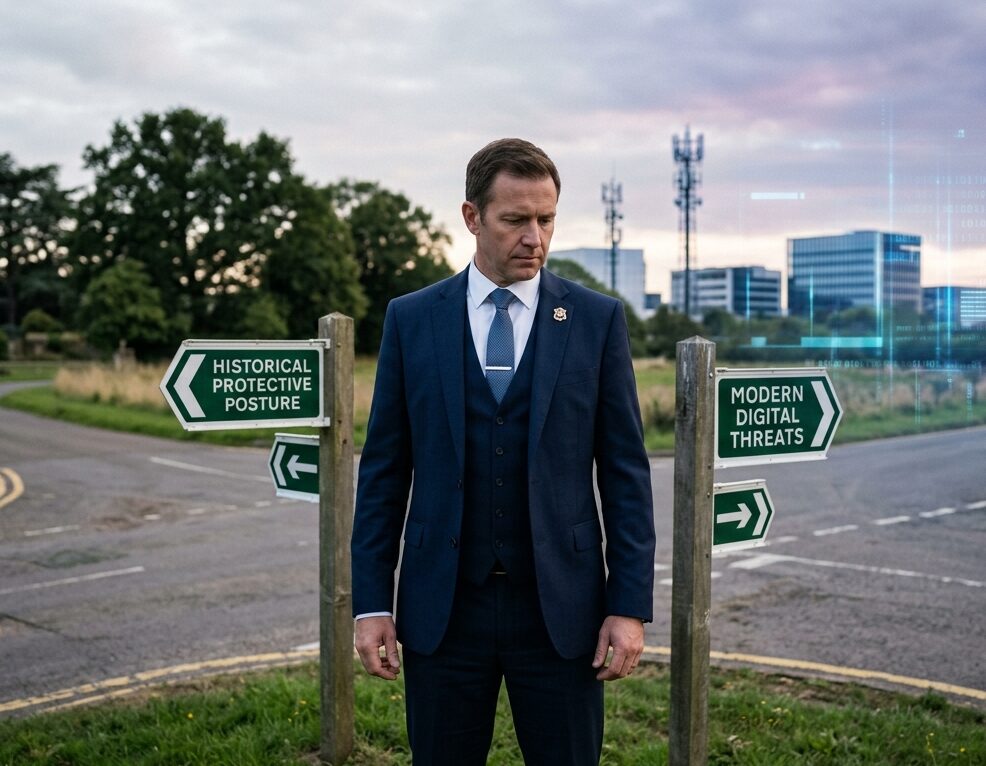
The true evolution of the modern threat landscape lies in convergence rather than a simple increase in volume, requiring a unified approach to physical, digital, and reputational security. Because cyber intrusions often serve as the precursor to physical targeting, and digital attacks like doxxing or deepfakes act as critical pre-incident indicators, security teams must recognize how online sentiment can rapidly escalate into real-world action.
EP requires the integration of inward-facing threat assessment teams capable of managing these overlapping risks within a single, cohesive operational system. This is where many Fortune 500 programs fall short, not because the threat is increasing, but because the operating environment has become exponentially more complex. You may have 8 balls in the air, but only one needs to fall for the system to unravel. Executive Protection now sits at a true crossroads with technology. The threat landscape is no longer linear or purely physical; it’s layered, interconnected, and often initiated in the digital domain before it ever manifests in the real world.
Teams must also be networked, not siloed. That means integrating with cybersecurity, corporate communications, HR, legal, and even external intelligence providers to build a holistic threat picture. Without this integration, teams remain trapped in a reactive posture, responding to incidents after they have already matured, rather than disrupting or preparing for them.
This profession is no longer defined by physical presence alone. The days of relying purely on size, proximity, and reaction time are over. Executive protection has matured into a discipline that demands analytical thinking, technical fluency, and the ability to anticipate rather than simply respond. It is no longer a blunt-force profession; it is an intelligence-driven function operating across a multi-domain environment, where the first indicator of trouble is rarely physical, but the consequences ultimately are.
That said, (and before someone starts telling me their bench press stats), this isn’t a dismissal of physical capability. You need bad men and women to confront other bad men and women. Strength, presence, and the willingness to address violence will always be part of the job. When things go bad, there must be a response. But capability without cognition is a liability. The modern professional must pair physical readiness with situational awareness, data-informed decision-making, and disciplined restraint. In short, the job hasn’t gotten softer; it’s gotten smarter.
Standards, Governance, and Defensibility
The ultimate success of a protection program in today’s complex environment hinges on a single factor: Standardization. Historically, the executive protection industry has been hampered by personality-driven operations that vary wildly across different sectors and regions, resulting in inconsistent training pipelines and a lack of unified operational doctrine. This fragmentation has made it difficult for organizations to establish a common language or rely on a set of universal best practices, often leaving security posture dependent on the individual preferences of practitioners rather than proven methodologies.
The emergence of national-level standards, such as those promoted by the Board of Executive Protection Professionals (BEPP), signals a critical shift toward true industry professionalization and enhanced legal defensibility. These best practices move the industry away from a “one size fits all” approach and toward scalable program designs rooted in objective threat assessments. By adopting these standards, organizations can ensure their protective programs are not only more effective and consistent but also better equipped to withstand the scrutiny of corporate boards and legal oversight.
In an era of heightened scrutiny, you don’t get judged by intent; you get judged by results. I don’t want to belabor the Standards issue because time will eventually validate the premise and the significant effort to create them.
Intelligence-Led Protection (Without the Hype)
There is a lot of noise around AI and predictive security modelling. Some of it is legitimate; much of it is marketing. The reality sits in the middle:
- AI does accelerate pattern recognition and data aggregation
- AI does not replace human judgment, intuition, or physical response
Executive Protection is moving from reactive coverage to intelligence-informed anticipation at light speed. Not because the world is more dangerous, but because we now have the tools to see more of it, earlier and faster.
The Modern Professional: Beyond the “Bodyguard” Archetype
The outdated “big bodyguard” stereotype is rapidly fading, not because physical capability has lost its relevance (see above), but because it is no longer sufficient in isolation. The modern practitioner must now possess a sophisticated, multi-dimensional skill set that prioritizes social adaptability and technical awareness to navigate complex corporate and private environments. Beyond mere physical presence, today’s professionals must be operationally discreet and both strategically and legally literate, ensuring they can provide comprehensive protection that aligns with the requirements of the contemporary threat landscape and needs of the consumer.
Uninformed clients will always buy physical presence, but the more educated marketplace is buying capability across all sectors. Your friend’s cousin, who blew out his knee at Old Miss, may still have a chance in this field, but only if he accepts considerable training beyond the tackle dummy. The EP personnel succeeding in the industry today recognize that diversifying their skillset into areas like emergency medicine, TSCM, advanced protective driving, and ASO training increases their attractiveness to potential employers.
Don’t Be Chicken Little
In a landscape of instant scrutiny and constant media coverage, we cannot allow rumor to outpace reality. Reacting to “noise” leads to over-engineered solutions, wasted resources, and a loss of credibility with stakeholders who value results over optics.
The industry continues to face serious challenges, specifically regarding how we address protective deficiencies and the targeting of protectees. As highlighted in the Board of Executive Protection Professionals’ publication, The Price of Inaction, the issue isn’t necessarily a spike in the number of events, but rather the catastrophic consequences of failing to prepare for them correctly.
For those working in Executive Protection, the sky isn’t falling, but your clients and peers are watching closely to see if you have the composure to respond correctly and know the difference.